Non-Owner Car Insurance: What It Covers, Cost, and Who Needs It
By Brian O’Connell
Estimated reading time: 10 minutes
Topics Discussed in Article:
Table of contents
- Key takeaways
- What is non-owner car insurance?
- What does non-owner car insurance cover?
- What non-owner car insurance does NOT cover
- How non-owner car insurance works when you borrow or rent a car
- Who needs non-owner car insurance? (2026 list)
- 1) You borrow cars often
- 2) You rent cars regularly (work travel, frequent trips)
- 3) You use car-sharing services frequently
- 4) You’re “between cars” and want to avoid a coverage gap
- 5) You need an SR-22 (or FR-44) but don’t own a vehicle
- 6) You want higher liability limits than the owner carries
- 7) You drive different vehicles (not just one) across the month
- 8) You don’t own a car but want to be prepared for unexpected driving
- Who probably does NOT need non-owner car insurance
- Pros and cons of non-owner car insurance
- How much does non-owner car insurance cost in 2026?
- How to get non-owner car insurance (step-by-step)
- Methodology: where these 2026 figures come from
- Frequently asked questions (FAQ)
- Is non-owner car insurance worth it?
- Does non-owner car insurance cover rental cars?
- Does non-owner car insurance cover me in a friend’s car?
- Can I get non-owner insurance if I need an SR-22 but don’t own a car?
- Does a non-owner policy cover my own injuries?
- Will non-owner insurance cover me if I live with someone who owns a car?
- Can I switch from a non-owner policy to a regular policy later?
- Bottom line: should you buy non-owner car insurance in 2026?

If you drive often but don’t own a car, you might assume you don’t need auto insurance. But even when you’re borrowing a friend’s vehicle, renting for work travel, or using a car-sharing app, you can still be financially on the hook after an accident—especially if the car owner’s liability limits aren’t high enough.
Non-owner car insurance is designed for this exact situation. It’s typically a liability-only policy that follows you as a driver (not a specific vehicle). It can help cover injuries and property damage you cause while driving cars you don’t own—and it can be a smart way to maintain continuous insurance history when you’re between vehicles.
Key takeaways
- Non-owner car insurance is usually liability coverage for drivers who don’t own a vehicle but still drive regularly (rentals, borrowing, car-share).
- It commonly acts as secondary coverage after the car owner’s policy pays first.
- It typically does NOT cover damage to the car you’re driving (no collision/comprehensive).
- In 2026, a non-owner policy is often much cheaper than a standard car insurance policy—but prices vary by state, driving record, and coverage limits.
- Non-owner coverage can help if you need to file an SR-22/FR-44 but don’t own a car.
What is non-owner car insurance?
Non-owner car insurance is a type of auto policy that provides liability coverage for people who:
- Have a valid driver’s license,
- Don’t own (or lease) a car, and
- Still drive regularly enough that relying on someone else’s policy feels risky.
Think of it as “car insurance without owning a car.” It’s especially common for frequent renters, frequent borrowers, and drivers who need proof of insurance for licensing reasons.
What does non-owner car insurance cover?
Most non-owner policies are built around liability coverage—the portion of auto insurance that pays for other people’s injuries and property damage when you cause an accident.
| Coverage type | Usually included? | What it helps pay for |
|---|---|---|
| Bodily injury liability | Yes | Other people’s medical bills, lost wages, legal costs after an at-fault accident |
| Property damage liability | Yes | Damage you cause to another person’s car or property (fence, mailbox, building, etc.) |
| Uninsured/underinsured motorist | Depends on state/insurer | Injuries (and sometimes property damage) if you’re hit by a driver with little/no insurance |
| Medical payments (MedPay) / PIP | Sometimes | Medical costs for you and passengers (availability varies, especially by no-fault state rules) |
Important: Coverage details vary by company and state. Always confirm what’s included and the limits before buying.
What non-owner car insurance does NOT cover
Non-owner car insurance is not a full “everything” policy. Common exclusions include:
- Damage to the car you’re driving (no collision coverage)
- Theft, vandalism, or weather damage to the car you’re driving (no comprehensive coverage)
- Rental car “physical damage” costs unless you separately purchase a collision damage waiver (CDW/LDW) or have coverage through a credit card benefit
- Vehicles you have regular access to (example: a partner’s car you drive every week) — insurers often want you listed on the owner’s policy instead
- Business/commercial driving in many cases (depends on vehicle use and policy terms)
If your driving situation involves one specific vehicle that you use all the time, you’re often better off being added as a listed driver on the owner’s policy.
How non-owner car insurance works when you borrow or rent a car
In most cases, car insurance follows the car. That means the vehicle owner’s policy generally pays first after an accident (as long as you had permission to drive).
A non-owner policy typically provides an extra layer of liability protection if:
- The owner’s policy limits are too low to cover the full damage/injury costs, or
- You’re not fully covered under the owner’s policy due to restrictions, exclusions, or coverage limitations.
Example scenario (simple)
You borrow a friend’s car and cause an accident. The total injuries and damages you’re responsible for add up to $60,000. Your friend’s liability limit is $25,000. In many scenarios, your friend’s policy pays up to their limit first, and your non-owner policy can help cover the remaining liability costs (up to your policy limits).
Bottom line: Non-owner coverage can reduce your risk of paying out-of-pocket or facing a lawsuit when the owner’s policy isn’t enough.
Who needs non-owner car insurance? (2026 list)
If any of the following scenarios sound like you, a non-owner policy may be worth pricing out.
1) You borrow cars often
Maybe you don’t own a car in the city, but you drive a friend’s car on weekends or run errands for family. If borrowing is frequent, non-owner coverage can be a smart backstop.
2) You rent cars regularly (work travel, frequent trips)
Renting a few times a year is one thing. Renting monthly for work is another. Non-owner insurance can sometimes be cheaper than repeatedly buying extra liability coverage at the rental counter.
3) You use car-sharing services frequently
Car-share companies often include some insurance, but limits may be close to state minimums. If you want higher liability protection, a non-owner policy can help supplement (where allowed).
4) You’re “between cars” and want to avoid a coverage gap
If you sold your car, moved, or are waiting to buy a new vehicle, a non-owner policy may help you keep an active insurance history. That can matter because many insurers price “continuous coverage” more favorably than a long lapse.
5) You need an SR-22 (or FR-44) but don’t own a vehicle
An SR-22 isn’t insurance—it’s a state-required filing that proves you carry at least the minimum liability coverage required. If the state or court requires you to file an SR-22 and you don’t own a car, you may be able to satisfy the requirement with a non-owner SR-22 policy.
6) You want higher liability limits than the owner carries
If you sometimes borrow vehicles from people who carry only minimum coverage, a non-owner policy can help protect you if damages exceed their limits.
7) You drive different vehicles (not just one) across the month
This can apply to people who rotate between rentals, borrowed cars, and car-share vehicles. Because the policy follows you (the driver), it can be a cleaner solution than trying to juggle multiple add-on coverages.
8) You don’t own a car but want to be prepared for unexpected driving
If you frequently find yourself needing to drive (family needs, emergency situations, helping friends), non-owner insurance can provide consistent liability protection.
Who probably does NOT need non-owner car insurance
Non-owner coverage isn’t right for everyone. You may not need it if:
- You live with someone who owns a car you drive regularly. In many cases, the owner should list you as a driver on their policy.
- You regularly drive the same vehicle (even if it’s not yours). Insurers often want that situation handled on the owner’s policy.
- You drive only a couple times per year. It may be cheaper to rely on the owner’s coverage or purchase coverage at the rental counter for those rare occasions.
- You own or lease a vehicle. You’ll usually need a standard policy tied to that car.
Pros and cons of non-owner car insurance
Pros
- Liability protection when you drive cars you don’t own
- Often cheaper than a standard policy (because there’s no vehicle being insured for physical damage)
- Helps avoid coverage gaps when you’re between cars
- Can help satisfy SR-22/FR-44 requirements if you don’t own a car
Cons
- Doesn’t cover damage to the car you’re driving (no collision/comprehensive)
- May not apply if you have regular access to a household car or drive the same borrowed car constantly
- Not available from every insurer (you may need to call an agent)
How much does non-owner car insurance cost in 2026?
Non-owner insurance is usually significantly less expensive than standard auto insurance—but the “right” number depends on your state, record, and the liability limits you choose.
2026 cost benchmarks (helpful context)
To give you a realistic starting point:
- Insurance.com (updated Jan 2026) reports the average cost of non-owner car insurance is $407 per year.
- NerdWallet’s January 2026 rate analysis puts average standard auto insurance costs around $629/year for minimum coverage and $2,339/year for full coverage.
Why this matters: Non-owner policies don’t insure a specific vehicle for collision/comprehensive damage, which is one reason they’re often cheaper than “full coverage” policies—especially compared to brand-new 2026 car insurance rates for drivers insuring newer vehicles.
| Policy type | What it typically includes | Example average cost (published sources) |
|---|---|---|
| Non-owner car insurance | Liability-focused (varies by state) | $407/year (Insurance.com, updated Jan 2026) |
| Standard minimum coverage | State-required liability minimums | $629/year (NerdWallet Jan 2026 analysis) |
| Standard full coverage | Liability + comp/collision (usually) | $2,339/year (NerdWallet Jan 2026 analysis) |
These are published averages and are not personalized quotes. Your price may be higher or lower depending on your state, driving history, age, coverage limits, and whether an SR-22/FR-44 is required.
What makes non-owner insurance cheaper (most of the time)?
- No vehicle insured for physical damage (no collision/comprehensive)
- Often lower driving frequency compared to a typical car owner
- Liability-only focus (in many cases)
What can make your non-owner cost higher?
- Tickets, accidents, or DUI history
- Needing an SR-22/FR-44 filing
- Choosing higher liability limits
- Living in a higher-cost state/metro area
How to get non-owner car insurance (step-by-step)
- Confirm you qualify. Typically, insurers want you to be licensed, not own a car, and not have regular access to a household vehicle.
- Decide your liability limits. State minimums may not be enough for a serious accident. If you have savings/assets to protect, consider higher limits.
- Ask about required add-ons. Depending on your state, you may need uninsured motorist coverage, PIP/MedPay, or an SR-22 filing.
- Compare multiple quotes. Not all insurers advertise non-owner policies online, so you may need to call an agent.
- Get proof of insurance. Keep your ID card handy—especially if you rent cars often or need proof for reinstatement purposes.
Fastest next step: Start comparing auto insurance quotes and ask specifically for a “non-owner” policy option.
Methodology: where these 2026 figures come from
This guide references publicly available 2026 rate analyses and insurer/government educational resources, including:
- Insurance.com’s non-owner insurance average cost figures (updated January 2026)
- NerdWallet’s published January 2026 auto insurance rate analysis for national average pricing context
- Carrier guidance from companies like GEICO, Progressive, and Nationwide about what non-owner policies typically cover
- Government information about SR-22 requirements and definitions (example: state Secretary of State / DMV resources)
Actual premiums vary. For the most accurate price, compare personalized quotes.
Frequently asked questions (FAQ)
Is non-owner car insurance worth it?
It can be worth it if you drive frequently enough that relying on someone else’s liability limits feels risky—or if you need continuous coverage or an SR-22/FR-44. If you drive only a couple times per year, it may not pencil out.
Does non-owner car insurance cover rental cars?
It can cover liability while driving a rental (injuries/damage you cause to others), but it typically won’t cover damage to the rental car itself. For that, you may need the rental company’s collision damage waiver or other protection.
Does non-owner car insurance cover me in a friend’s car?
Often yes—if you have permission to drive and you don’t have regular access to that vehicle. Typically, the owner’s policy pays first, and your non-owner policy can help if liability costs exceed the owner’s limits.
Can I get non-owner insurance if I need an SR-22 but don’t own a car?
In many states, yes. A non-owner SR-22 policy may satisfy the filing requirement without being tied to a specific vehicle. Always confirm with your insurer and your state.
Does a non-owner policy cover my own injuries?
Usually not by default. Some policies may offer optional coverage like MedPay or PIP depending on your state and insurer, but non-owner insurance is typically liability-focused.
Will non-owner insurance cover me if I live with someone who owns a car?
Often, insurers will prefer you be listed on the household vehicle owner’s policy if you have regular access to that car. Non-owner insurance is usually intended for drivers who don’t have regular access to a vehicle.
Can I switch from a non-owner policy to a regular policy later?
Yes. If you buy a car, you’ll typically switch to a standard policy that insures the vehicle (and can include collision/comprehensive if you want “full coverage”).
Bottom line: should you buy non-owner car insurance in 2026?
If you’re a frequent driver who doesn’t own a car, non-owner car insurance can be a cost-effective way to protect yourself from major liability costs, avoid coverage gaps, and meet state requirements when needed.
Best next step: compare quotes and confirm eligibility rules (especially around household vehicles and “regular access”).
Compare options now: Get non-owner car insurance quotes.
How New Claims Affect Your Car Insurance Premiums (2026 Guide)
By Lauren Pezzullo
Estimated reading time: 10 minutes
Topics Discussed in Article:
Table of contents
- Key Takeaways
- Why Insurance Rates Go Up After a Claim
- What Types of Claims Raise Your Auto Rates the Most?
- How Long Will Your Rates Stay High?
- Does an Accident Forgiveness Program Help?
- What About Accidents That Weren’t Your Fault?
- How to Avoid Rate Increases: Practical Tips
- Should You Ever Not File a Claim?
- Should I File or Pay Our of Pocket?
- How We Built Our Guide
- FAQs: New Claims in 2026
If you’ve ever filed a car insurance claim and then watched your premium jump afterward, you’re not alone. Insurers really do raise rates after certain kinds of claims, even for long-time customers. It’s frustrating: you filed the claim because you needed help, not because you wanted your bill to go up. But once you know why premiums increase, you can spot when a claim might cost you more later, keep your rates manageable, and even snag a better deal when it’s time to shop around.

So, will filing a car insurance claim raise your premiums? Quick Answer
Filing a car insurance claim can raise your premium because insurers see claims as a signal of future risk. Increases depend on the claim type (at-fault vs comprehensive), claim cost, your driving history, and your insurer’s pricing rules. Most claims affect rates for about 3–5 years, but you can reduce the impact with accident forgiveness, smart coverage choices, and shopping at renewal.
Key Takeaways
- At-fault accident claims are the most likely to increase your rate (especially if injuries are involved).
- Comprehensive claims (theft, hail, animal hits) may raise rates, but usually less than at-fault collisions.
- Claims typically influence premiums for ~3–5 years, depending on state and insurer.
- Claim frequency matters: multiple claims in a short window often costs more than one isolated incident.
- Sometimes it’s smarter to pay out of pocket if the repair cost is close to your deductible.
| Claim type | Likelihood of rate increase | Why it matters |
|---|---|---|
| At-fault collision | High | Signals higher future risk + higher claim severity |
| Not-at-fault accident | Medium (varies) | Some insurers still price based on overall claim frequency |
| Comprehensive (theft, hail, animal) | Low–Medium | Often lower impact, but can add up if repeated |
| Glass-only claim | Low | Usually smaller severity, varies by carrier/state |
| Injury/medical payouts | Very high | Higher costs and longer claim development |
- Rules vary by state and insurer—this guide explains the most common outcomes and how to protect your rate.
Now that we know the basics, let’s walk through the details of why claims raise rates, when they don’t, and how to avoid overpaying.
Why Insurance Rates Go Up After a Claim
Car insurance is pretty much a numbers game. Each company is trying to answer the same questions: How risky are you to insure?
So when you file a claim, especially a big one, it sends up a little flag for them. The company sees it as a signal that you’re more likely to file another claim in the future. And statistically, people who file one claim are more likely to file another.
Because of that, your premium usually goes up, although not as a punishment, but because they’re recalculating how risky they think you are. And just to make things even more fun, not all claims affect your rates the same way. Insurers charge different rate increases depending on:
- Who caused the accident
- How expensive the damage was
- What type of claim it was (collision, comprehensive, injury, etc.)
- Your driving history
- How long you’ve been with the company
A tiny ding in your car door may barely affect your premium, or not at all. A $3,000 collision claim, on the other hand, can increase your rates for the next three years.
What Types of Claims Raise Your Auto Rates the Most?
Not all claims are treated the same; some have a bigger price tag than others. Here’s the general ranking, starting with the least likely to raise your rates to almost guaranteed to raise your rates.
- Comprehensive claims (usually the least impact) – These are the “act of nature” or “not your fault” situations, such as:
- Hail
- A tree branch falling
- Vandalism
- Hitting a deer
It’s uncommon for an insurer to raise your rates over just one of these situations. In most cases, it’ll take multiple incidents within a short period before they’ll even consider it. And when an increase does happen, it’s usually pretty small.
- Minor at-fault claims (moderate impact) – These are lower-cost accidents where you’re responsible, such as:
- Hitting a mailbox
- Scraping a parked vehicle
- Backing into a pole or barrier
When the payout is relatively low, say a few hundred to a couple thousand dollars, your increase may also be relatively small. That said, the impact can vary significantly depending on your insurance company.
- Bigger at-fault collision claims (high impact) – This type of claim is when premium rates rise the most. If you caused:
- A serious crash
- Significant property damage
- An accident involving injuries
- A claim over $2,000–$5,000
- In these cases, you can expect a noticeable rate increase, usually lasting three to five years.
- Injury claims (the biggest impact of all) – Claims involving injuries are the most costly for insurers. Medical bills, lost income, and potential legal expenses can escalate quickly. If you’re responsible for an accident that causes injuries to others, it’s one of the strongest indicators that your rates will increase — and by a significant margin.
How Long Will Your Rates Stay High?
Here’s the part that catches a lot of people off guard: most rate increases stick around for 3 to 5 years. And if a claim was especially expensive, a few companies may keep it on their radar even longer. The upside is that increase usually shrinks a little each year until it disappears completely. So while a rate hike is frustrating, it’s not permanent.
Does an Accident Forgiveness Program Help?
Sometimes, but it depends. A lot of insurance companies offer accident forgiveness for drivers with clean driving records, which means your first at-fault accident won’t raise your rates. But here’s what people don’t always realize:
- Not every accident qualifies
- You usually only get it once for the life of the policy
- Some companies charge extra for it
- You need a solid, clean driving history to qualify
- It doesn’t transfer, so if you switch insurers, you lose it.
- So if you’re shopping for coverage or comparing quotes, take a closer look at accident forgiveness and ask:
- Is it already included?
- Is it optional (and does it cost extra)?
- Is it actually worth it for your driving habits?
What About Accidents That Weren’t Your Fault?
This one surprises a lot of drivers. In many states, insurance companies aren’t allowed to raise your rates if an accident wasn’t your fault. But that protection isn’t true everywhere, and even where it exists, some insurers still bump premiums slightly. Why? Because from their point of view:
- Even a no-fault accident shows you’re on the road often.
- You may be more likely to file another claim later.
- Insurers look at claim frequency, not just who caused them,
- Always check your state’s rules and your policy details. If you truly weren’t at fault, you might be able to push back on a surcharge.
How to Avoid Rate Increases: Practical Tips
Here’s the part that most people want to know: how to keep your insurance from getting more expensive than it needs to be.
- Skip the claim if the damage is small. This is the biggest one. If the repair cost is close to your deductible, filing a claim almost never makes sense. It can actually cost you more in the long run. For example:
- Deductible: $500
- Damage: $900
- Surcharge: $200/year for 3 years = $600
- In this case, filing the claim ends up costing more than the repair. Rule of thumb: if the damage is within about $1,500 of your deductible, it’s often cheaper to pay out of pocket.
- Get a repair estimate before calling your insurer. You can get estimates all day long without triggering a claim. But calling your insurer first? Sometimes that creates a “claim inquiry,” which some companies treat like an actual claim even if no claim is filed. Get the estimate first, then decide whether to file.
- Raise your deductible (strategically). If you rarely file claims, a higher deductible — like $1,000 instead of $500 — can lower your premium and discourage small claims that lead to surcharges. If you’ve got a little cushion in your emergency fund, a higher deductible is almost always worth it.
- Ask about accident forgiveness. If you have a good driving record, some insurers include it automatically. It can save you hundreds of dollars after one at-fault accident.
- Shop around every year, especially after a claim. This is an important one. You don’t have to stay with the insurer that raised your rates. Here’s how different insurers handle claims very differently:
- Some surcharge heavily, even for small claims
- Others barely react unless injuries are involved
- Some only penalize at-fault accidents
- Switching insurers when a surcharge hits can save you a lot.
- Take advantage of bundling and discounts. Even if your premium goes up, you can often drop your costs by:
- Bundling auto insurance with home or renters coverage
- Enrolling in a safe-driver or usage-based (telematics) program
- Paying your policy in full using automatic payments
- Taking a defensive driving course
- Asking about discounts if you drive fewer miles
- Keep your record clean going forward. One claim by itself usually isn’t a deal-breaker, but back-to-back claims can send rates soaring. A nice stretch with no claims will help bring your premium back down.
Should You Ever Not File a Claim?
You should always file a claim if:
- Someone is hurt
- The damage is significant
- Another driver is involved
- There’s a chance of a lawsuit
- You hit another driver
- You’re unsure who’s at fault
For small, out-of-pocket repairs (small dings or cosmetic damage), it’s worth doing the math first before filing.
Should I File or Pay Our of Pocket?
Break-even rule of thumb: If your out-of-pocket cost is close to your deductible, filing a claim may cost more long-term.
Simple estimate:
- Repair cost – deductible = what the insurer would pay
- Estimate your premium increase at renewal (even a small increase adds up over years)
- Multiply the annual increase by 3 years (typical impact window)
- If the total projected increase is higher than the insurer payout, consider paying out of pocket.
Example:
- Repair: $1,200, deductible: $1,000 → insurer payout: $200
- If premiums rise by $15/month: $180/year × 3 years = $540
- Paying out of pocket may be the cheaper path.
Free Car Insurance Quotes — See What You Qualify For
You wouldn’t buy the first car you see, so why settle for the first insurance policy you find? A little comparison shopping can go a long way, especially when it comes to saving money. Get a free auto insurance quote now and make sure you’re getting the best deal on the coverage you need.
How We Built Our Guide
This article explains common pricing patterns insurers use after claims, including how claim type, severity, and frequency may influence premiums. Rules vary by carrier and state. For the most accurate outcome, confirm with your insurer and review your state insurance department’s consumer guidance.
FAQs: New Claims in 2026
Not always. Many factors affect it, including claim type, cost, and whether you were at fault. Some first claims may have little impact depending on your insurer.
Often around 3–5 years, but it can vary by insurer and state.
Sometimes, but typically less than at-fault accidents. Repeated comprehensive claims can increase risk perception.
It depends. Some insurers factor overall claim activity into pricing, even if you weren’t at fault.
Usually low impact, but carrier rules vary—especially if you file multiple glass claims.
There’s no universal number. The change depends on severity, injuries, prior history, and your insurer’s pricing model.
It can be—especially for drivers with clean records—because it may prevent a surcharge after a first at-fault accident (with restrictions).
If the insurer payout would be small (close to your deductible), paying out of pocket can avoid a multi-year premium impact.
Often yes. Claim frequency is a strong risk signal in many pricing models.
Yes—shop at renewal, ask about accident forgiveness eligibility, adjust deductibles thoughtfully, and use discounts/telematics if it fits.
No. Claims can still appear in insurance databases and influence quotes across carriers.
You can request a copy of your claim report (often through consumer reporting services used by insurers) and verify details for accuracy.
2026 Insurance Outlook: What Consumers Can Expect
By Brian O’Connell
Estimated reading time: 12 minutes
Topic Details in this 2026 Insurance Report
Table of contents
- The Customer Outlook: Consumer Behavior Is Changing: Shoppers Are Smarter, More Active, and More Digital
- AI Is Reshaping Insurance; Speeding Service, Changing Pricing, But Raising New Risks
- Government & Regulation: What 2026 Policy Decisions Mean for Consumers
- Tips for Consumers: How to Save Money and Reduce Insurance Angst in 2026
- The Takeaway: The Long-Term Outlook and Short-Term Implications

The US insurance sector is in acceleration mode heading into 2026, with total market size expected to exceed $3 trillion by the end of next year and an 8.5% compound annual growth rate from 2023 to 2027.
The U.S. insurance landscape is shifting faster than at any time in the past decade.
Premiums across home, auto, health, and even life insurance continue to trend upward. Artificial intelligence is reshaping underwriting and claims. Climate-driven disasters are forcing insurers to redraw risk maps and, in some areas, pull back entirely. And a handful of federal policy decisions, particularly involving the Affordable Care Act (ACA), could determine whether millions of Americans pay hundreds or even thousands more per year for coverage.
Yet experts say the picture isn’t all doom and gloom. While affordability pressures remain intense, consumers also have more tools, more transparency, and more ways than ever to take control of their insurance costs.
“Affordability will dominate the consumer experience in 2026,” said Kami Adams, founder of Creative Legacy Group and a licensed benefits advisor in more than 30 states. “But consumers who stay informed, shop early, and take practical steps like mitigating home risks or reviewing subsidies will be best positioned to manage rising costs.”
Here’s what Americans can expect from their 2026 insurance experience and what they can do about potential logjams.
The Customer Outlook: Consumer Behavior Is Changing: Shoppers Are Smarter, More Active, and More Digital
The insurance industry is showing significant resilience against rising tides like continued stubborn inflation, a more stringent regulatory outlook, higher catastrophe losses, ongoing climate change risks, and major customer experience angst, thanks mainly to rising policy prices in key areas like home, life, health, and auto insurance.
That’s leading to an insurance market fissure, splitting customers into two disparate groups and making policy management all the more challenging.
A case in point. According to AI-driven predictive marketing intelligence company Sooth, there’ll be a divide between “cost management” and “stress management” insurance shoppers throughout 2026.
“Affordability pressure creates two distinct mindsets,” said Ian Baer, founder and CEO at Sooth, “The first group—younger, renter-heavy—treats insurance like a streaming subscription: something to pause, downgrade, or rotate based on price. The second group, homeowners in climate-vulnerable areas and families facing healthcare costs, will increase coverage despite complaining about premiums.”
The “save money” messaging attracts low-value switchers, while the “peace of mind” messaging will appeal to customers who stick and spend, Baer added.
Insurers should also expect more frequent comparison shopping, which is already being hyper-scaled on the digital markets front.
“People are shopping around more often, raising deductibles, trimming optional coverages,” said Gregg Barrett, CEO of Waterstreet Company in Bigfork, Montana
Home Insurance: Climate Losses, Reinsurance, and Market Retreats
Climate awareness is also rising among consumers, especially asmore homeowners now take insurers’ mitigation recommendations seriously. Fire-proof roofing, water-leak sensors, defensible space, and hurricane shutters are in demand, as these upgrades can materially affect premiums and insurability.
In the climate realm,the property insurance market remains the most volatile. Repeated climate-driven disasters, including wildfires in the West, hurricanes in the Southeast, and severe convective storms across the rest of the country, continue to push claim severity higher.
“Home and auto premiums have climbed sharply as insurers cope with bigger weather losses, pricier repairs, and more expensive reinsurance,” Barrett said. “That pressure is most intense in coastal and wildfire-exposed states like California and Florida, where some companies are cutting back or exiting altogether.”
To insurers, the retreat is all too real. Several national carriers have limited new business in high-risk ZIP codes, while smaller regional carriers have failed outright.
To stabilize markets, several states are attempting to modernize rate regulation and strengthen FAIR Plans, state-run insurers of last resort. That impact should be delayed. “Those fixes take time to show up in consumer bills,” Barrett noted.
Other industry experts say that the market will increasingly reward households that take physical steps to reduce risk.
“Coverage of climate-related perils is evolving, particularly in locations devastated by fires and on the coast,” said Mario Serralta, a Florida-based insurance attorney, who said he sees this trend daily. “Insurers are pushing proactive mitigation; roofing upgrades, shutters, defensible space,” he stated. “Long-term access in high-risk areas will depend on it.”
Auto Insurance: Moderation, But No Major Relief
Auto premiums spiked from 2022 to 2024 for several reasons, notably inflation, supply-chain delays, and higher repair costs driven by tech-integrated vehicles. The good news? Those pressures have eased, but not to the degree consumers hoped.
“Inflation is moderating, but claims severity still drives higher rates in some areas,” Adams said.
Other market veterans say some cost issues are temporary, while others are more or less permanent.
Health Insurance: All Eyes on ACA Subsidies
The affordability wildcard for 2026 is health insurance, and specifically whether Congress extends enhanced ACA premium tax credits.
“If enhanced ACA subsidies weaken, patients won’t just get higher bills,” said Dr. William Soliman, CEO of the Accreditation Council for Medical Affairs. “There will be a chain reaction that causes more denials, tougher prior authorizations, and more delays in care.”
Without subsidy extensions, millions could see double-digit premium increases in 2026. With extensions, premiums remain more stable for most marketplace enrollees. Life insurance remains the most stable category, with pricing that is moderate and predictable, tied to age and health.
AI Is Reshaping Insurance; Speeding Service, Changing Pricing, But Raising New Risks
If 2025 was the year insurers broadly integrated AI, 2026 is the year consumers begin to feel those changes firsthand.
“Artificial intelligence is quietly rewiring consumer insurance from the inside out,” Barrett said. “Insurers are using AI to sift through vast amounts of data in underwriting, speed claims handling, and power 24/7 chatbots. When done well, it means faster service and more accurate pricing.”
What can consumers expect to see? Experts cite these AI-powered customer experience upgrades.
- Shorter wait times for claim approvals
- More customized pricing
- Better fraud detection
- Lower administrative costs that could eventually reduce premiums
Many customers have already seen the benefits on the ground. “AI has made the communication process more efficient,” Serralta noted. “For instance, it can identify missing paperwork early, preventing delays.”
In the healthcare realm, AI’s impact could be transformative, though any pricing improvements remain on the horizon.
“In 2026, we’re going to start seeing drug development times shrink dramatically,” Soliman said. “What takes 8–10 years today may fall to 12–24 months. AI will cut clinical trial recruitment time by 50%.”
The biggest AI insurance risks lie in bias and opacity.
“Models trained on biased or incomplete data may misprice risk or disadvantage certain groups,” Adams said. “Consumers should ask questions and request human review if an AI-generated outcome seems incorrect.”
Other market mavens agree, noting that the public sector needs to rein in AI, and the sooner, the better. “Poorly designed algorithms can unintentionally discriminate or make mistakes that are hard to challenge,” Barrett stated. “So, regulators are now demanding explainable AI, clearer governance, and strong human oversight.”
Digital-footprint-based pricing is also emerging, adding another technology layer to the US insurance market.
“Insurers are using AI to price risk with terrifying precision,” said Matthew Bertram, a longtime AI strategist, warns consumers. “Your digital footprint, like gig work patterns, extreme-sports posts, even health-related behaviors, increasingly affects pricing.”
Insurers will have to keep pace as digital platforms and AI tools become standard for industry customers, especially younger households weaned on the internet and mobile apps. In this environment, consumers increasingly expect certain services to be fundamental and non-negotiable, such as instant quotes, chatbot assistance, usage-based pricing, and personalized policy recommendations.
Even so, they still want human support for complex issues.
“The companies that blend digital convenience with a human touch are seeing the most loyalty,” Barrett said.
Climate & Natural Disasters: The Biggest Long-Term Driver of Insurance Change
Climate-driven losses remain the defining challenge of the property insurance market, with insurers rewriting coverage risk maps in real time.
“Climate change has turned property insurance into a frontline issue,” Barrett said. That’s changed the coverage model, as insurers now use advanced catastrophe modeling, real-time satellite imagery, and AI-enhanced risk scoring to decide where they can profitably operate.
That rising trend should lead to these consumer-impacted outcomes.
- Harder underwriting in wildfire, flood, and coastal regions
- Higher deductibles
- Stricter home-inspection requirements
- Carriers exiting entire ZIP codes
Parametric Insurance Is Rising, Speeding Up Payments in the Process
To speed up payouts after disasters, insurers are experimenting with parametric policies, which automatically pay out when a measurable event occurs (for example, when a hurricane reaches Category 3 or wildfire smoke reaches a set threshold). As parametric insurance gains momentum, consumers may welcome an insurance experience with no adjusters or documentation.
Government & Regulation: What 2026 Policy Decisions Mean for Consumers
U.S. Consumers can expect health policy, especially ACA subsidies, to be a deciding factor in household decisions about health insurance value and cost.
The central policy question for 2026 is whether Congress extends enhanced ACA premium subsidies. Experts said they expect the ACA itself to remain intact, but the cost-shaping mechanics may shift.
“Most proposals maintain the ACA framework but adjust subsidy levels or expand HSA flexibility,” Adams said. “Consumers should run subsidy estimates early, as small income changes may drastically affect eligibility.”
On the homeowner front, state-level action on homeowners’ insurance will continue to accelerate.
Exhibit A is insurance reforms being implemented by US states, with Florida’s lawsuit-reform measures already lowering rates, according to Stacey Giulianti, chief legal officer at Windward Risk Managers in Tallahassee, Florida. Additionally, California is exploring modernized rate approvals and updates to catastrophe modeling, while coastal states are expanding public backstops like Citizens Property Insurance Corp.
Those scenarios should support consumer efforts to choose the best policy based on value, and not just cost.
“Don’t just seek cheaper premiums, shop carriers for the broadest possible coverage and the most robust limits,” Giulianti advises, adding that consumers should prioritize coverage adequacy over premium chasing. “If a loss occurs, you’ll want full rebuild protection, not a bargain policy that comes up short.”
Tips for Consumers: How to Save Money and Reduce Insurance Angst in 2026
Every expert agreed on one theme: Consumers who actively manage their insurance will save the most.
Here are the most actionable steps industry experts cited for 2026.
- Shop every renewal: Don’t assume last year’s plan is still best. Do your homework and see what new features and services insurers are offering in 2026 as well as compare your rates – let IQ help you compare by entering your zip code above.
- Check ACA subsidies: “A small income or household changes can affect eligibility,” Adams said.
- Raise deductibles strategically: Leveraging plan deductible options is doable, “but only if you have a safety fund,” Adams advised.
- Bundle carefully. Make sure to compare bundled versus standalone quotes when making any big insurance ‘combination platters.’
- Mitigate home risks. Protect your home and your pocketbook byinstalling shutters, roof upgrades, sump pumps, defensible space, and ask about discounts.
- Stay organized. “Keep a one-page summary of policies, renewal dates, deductibles, and contacts,” Adams noted. Make sure to include policy numbers, policy renewal dates, insurance deductibles, coverage limits, emergency contacts, and claims history.
- Bertram also stated that even one annual “documentation audit uncovers 15–20% waste on average.”
- Ask about AI decisions. If your claim is rejected digitally, request human review for denials or unusual premium changes.
- Shop early in high-risk areas. “Note that policies may be limited or sell out quickly,” Adams added.
- Be strategic about your digital footprint. Review digital-driven behavioral tracking habits, like limiting auto miles, not smoking, or going to the gym. In cutting overall household insurance costs, it’s free money if you don’t mind being tracked by an insurance device or software.
“If you’re going to let insurers monitor your behavior for a discount, make sure you’re gaming those metrics,” Bertram said.
- Review your policies regularly. Above all else, work with a trusted financial expert to ensure you’re optimizing your insurance experience for 2026 and not for 2025 anymore.
“Consumers should be aware of how insurance can easily fall out of alignment with one’s real-life circumstances,” said Chris Heerlein, CEO at REAP Financial, an investment advisory firm. “Insurance policies are set in place and renew automatically with rates increasing in most cases.”
Heerlein said it’s not unusual for an insurance policy to go several years without any changes or reviews. “As accumulating small changes are made within your home and work routine year after year, an insurance policy can easily become out-of-date, very quickly,” he noted. “All it takes is to bring every policy together and examine them as you would check your pantry before a shopping trip.”
Heerlein said he’s observed redundancies and deductibles that no longer match a person’s savings. “After a thorough inventory, many are better positioned to reach out to their agent and request quotes that better fit their current life stage,” he added. “Many clients were able to reduce their overall rate by 70% just by making this adjustment.”
The Takeaway: The Long-Term Outlook and Short-Term Implications
In the shorter term, the insurance landscape in 2026 will be shaped by three major forces: rising costs, accelerating AI adoption, and climate-inflated risks. Consumers cannot control those trends, but they can control how they respond.
“In 2026, rising costs, technology changes, climate risks, and policy decisions will shape insurance,” Adams said. “Consumers who shop smart, stay informed, and take practical steps like reviewing subsidies and mitigating home risks will be best positioned to save money and secure coverage.”
Over the next decade, experts expect two Americas to emerge, with implications for the insurance market, especially home insurance.
- Households that can pay for mitigation (impact-resistant roofs, flood retrofits) and afford higher premiums.
- Households that cannot may eventually have to relocate or rely on government support to cover insurance needs.
As Serralta notes, “Insurance industry developments affect long-term access in high-risk areas and encourage proactive consumer planning.”
If 2025 was a wake-up call for consumers, 2026 will be the year they take more control than ever over their policies, now and for the long haul.
Many shoppers may still see upward pressure in 2026 depending on location, claim severity, and insurer filings. The most reliable way to avoid overpaying is to compare options at renewal and make sure you’re matching coverage apples-to-apples.
Auto premiums jumped in recent years due to inflation, supply-chain delays, and higher repair costs—especially with more tech in vehicles. Some pressures have eased, but not always enough to deliver big drops for consumers.
A major wildcard is whether enhanced ACA premium tax credits get extended, which could meaningfully affect what many people pay for Marketplace plans.
AI is speeding up underwriting and claims workflows, and it can reduce delays by flagging missing paperwork earlier. But consumers should still watch for bias/opacity and ask for a human review if an outcome seems wrong.
Parametric insurance generally pays based on a defined trigger (like wind speed or rainfall) rather than a traditional adjuster-based loss estimate. It’s designed to speed up payments for certain event-driven losses.
Shop your policy before renewal, review deductibles and limits, ask about discounts (bundling, telematics, safety devices), and reduce risk factors where possible (home mitigation, safe-driving programs). Small changes can add up – especially when rates are moving.
Porch Pirates 2025 Holiday Shopping Trends
By Michael Giusti
Estimated reading time: 10 minutes
With the country as politically divided as it is, there is still one issue can bring people from different sides of the political spectrum together – the threat of porch pirates.
Each year, InsuranceQuotes.com partners with SSRS to survey people on their experience with package theft, along with the latest holiday shopping trends for this season of inflation, AI, among other timely factors
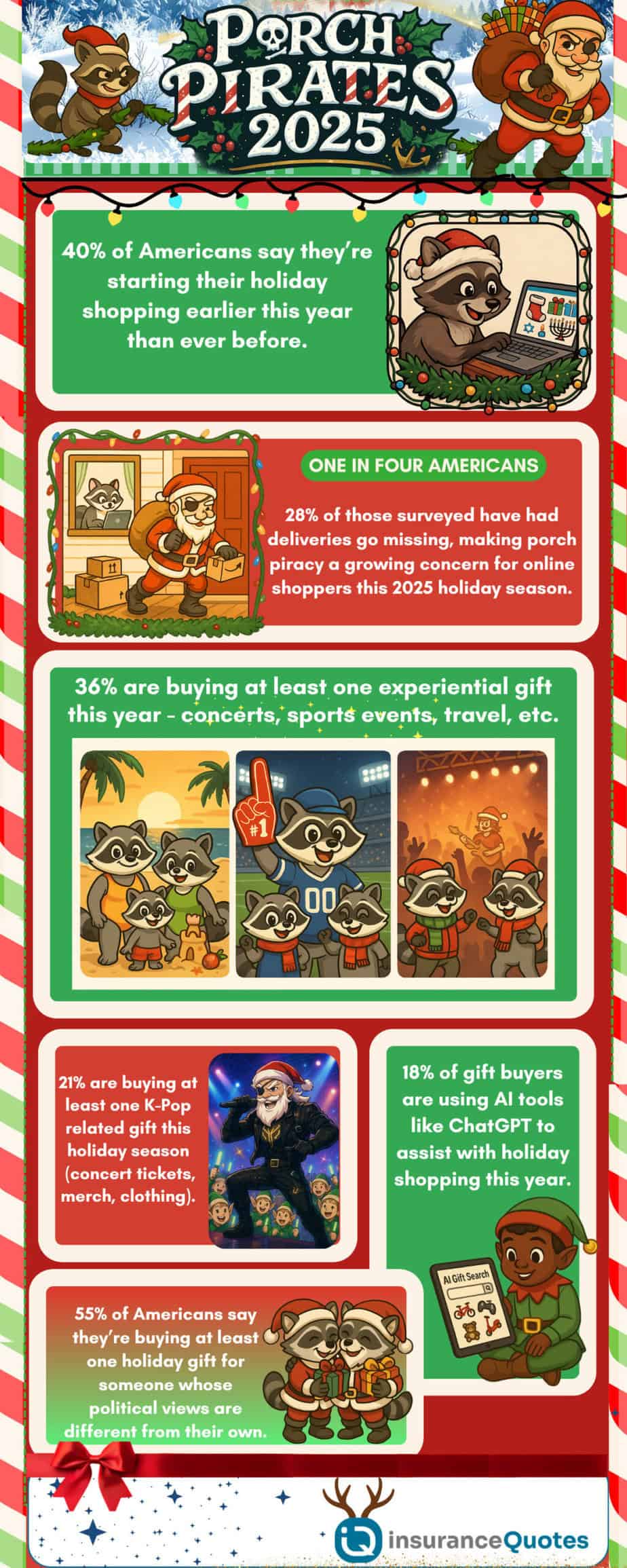
According to this year’s survey, 28% of Americans say they have had a delivered package stolen from their porch, doorstep or building lobby. And while that is more than a quarter of all respondents, it is a bit better than two years ago, when 31% of people responded that they were victims of porch piracy.
Among the youngest respondents, however, porch piracy was a much bigger problem, with 41% of 18 to 29-year-olds reporting having a package stolen, compared with just 14% of respondents older than 65.
And while the country may be divided politically, holiday shopping will be bringing many people together. According to our survey, 55% of respondents said they will be buying at least one holiday gift for someone whose political views are different from theirs.
People in the middle-income brackets – those earning between $75,000 and $100,000 — were most likely to say they were buying gifts for people with different politics, with 70% saying this applied to them. Political independents were the most likely to say they will be shopping for people whose politics differed from their own, with 59% saying yes, while Democrats were slightly less likely to say yes, with 51% saying this applied to them.
Regardless of political party, most people said they were feeling the financial pinch this holiday season, with 60% of respondents saying that due to rising prices, they’re scaling back on their holiday gift giving this year. The highest earning respondents seemed more insulated from prices, with only 51% of respondents earning more than $100,000 saying they were scaling back, compared with 65% of respondents earning $50,000 or less. But even among those earning between $75K-$100K, 64% responded that the high costs of goods is causing them to limit their holiday shopping.
Financial worries make some sense, with the Bureau of Labor Statistics reporting that inflation is up 3% compared with last year, all while the future of the newly imposed tariffs sits in front of the Supreme Court for review.
A reliance on artificial intelligence was a bit of a holiday shopping trend, but it differed widely by age. Among all the respondents, 18% say they are using ChatGPT or another similar AI tool to assist with their holiday shopping this year – a spike when compared with 13% last year.
But that trend didn’t hold among the older shoppers, with only 5% of respondents older than 65 saying they intend to use AI for their holiday shopping. There was a gender divide when it came to AI as well. Men in the survey were more likely than women (21 percent compared to 15 percent) to say they would use the AI tool to assist their holiday shopping.
Pop culture emerged as one of the drivers of holiday gift giving – specifically K-Pop.
Among our respondents, 21% said that, this holiday season, they’re buying at least one K-Pop-related gift, such as concert tickets, merchandise, clothing, etc. The youngest respondents were the ones most drawn to K-Pop, with 27% saying they planned to buy a K-Pop-related gift, compared with just 18% of those aged 50 to 64.
It is interesting to see the draw to pop-culture-inspired gift giving. A similar trend held true last year, with 8% of respondents said they were planning to buy a Taylor Swift-related gift, though the higher number this year suggests K-Pop may have a deeper gift-giving appeal.
Gifts this year don’t just include things that fit under the tree. This year, 36% of respondents said that, this holiday season, they’re buying at least one experiential gift (such as concert tickets, a sports event, travel, etc.). That’s a big jump from 2023 when only 28% said experiences were going to make up part of their gift giving.
This year, the highest earning respondents were the most likely to say they were gifting experiences, with half of respondents earning more than $100,000 saying they planned to buy at least one experiential gift, compared with just 33%, or about 1 in 3, of respondents earning less than $50,000.
Giving experiences has been growing as a trend for years now.
Our survey also suggests that people won’t be waiting to do their shopping, with 40% reporting that, this year, they’re starting their holiday shopping earlier than ever.
That trend makes some sense, especially with United States Postal Service timelines making shipping take longer than it has in years past.
Protecting Holiday Gifts
Shipping experts suggest a few best practices to keep porch pirates at bay this holiday season.
The first, most common suggestion is to know what is coming and when. Alisa Carroll, an Amazon spokeswoman, points out that tracking packages in real time means you can be at home when they are delivered and you can get them inside as soon as possible. The less time an item spends on the porch is less time a thief has to swipe your gifts.
Most major retailers offer customers the opportunity to offer hints or suggestions to the driver on where to best leave the package. Suggesting the best place to tuck a package away on or near your porch can keep the package out of sight and make it a less tempting target.
“We train our drivers to leave packages out of sight whenever possible,” said UPS spokesman Jim Mayer.
Even better than suggesting a bush or potted plant to tuck the package behind is to leave a secure location on the porch for drivers to deposit the package. There are self-locking drop boxes available for purchase that homeowners can install on their porches that drivers can tuck the packages into to keep them away from thieves.
Another option Mayer points out is that many shippers offer alternative locations customers can have their packages delivered to. Something like a UPS Store works as a pickup location, and other retail locations also volunteer to accept deliveries on behalf of customers, who can then come pick up their package just by showing their ID. Amazon even has a network of delivery lockers across the country people can access at all hours of the day.
Some carriers in some locations even have programs where they allow customers to provide drivers with a one-time-use remote code that allows the driver to open their garage door and leave the packages within the safety of the locked garage.
Simply having a visual deterrent goes a long way toward preventing package theft, as well.
“Even just having a highly visible camera that looks intimidating upon approaching can help keep thieves away and your home or property secure,” said Jeff Peel, CEO of security device maker Tactacam.
If the gift doesn’t come in a package, that doesn’t mean there isn’t a way to protect it, too. Experiential gifts might benefit from some insurance.
Some ticket marketplaces sell stand-alone coverage for the events they are selling.
But if the gift is a bit more elaborate, a full travel insurance policy might be in order. Travel insurance reimburses you for non-refundable expenses if a trip has to be called off due to unforeseen reasons. And if the gift was an expensive out-of-town concert, a travel policy might make sense. Buyers just need to declare the cost of the tickets when they are purchasing the policy as part of their trip so it can be included in the coverage.
Recovering From Piracy
One of the most heartbreaking things about porch piracy is that once the package is successfully delivered to a porch or a mailbox, the package is now exclusively the responsibility of the homeowner.
That doesn’t mean there isn’t recourse if a package is stolen, though.
The first thing to do if a package turns up missing is to check to see if it is in fact missing after all. A good first step is to check with the carrier for proof of delivery. Most carriers take pictures of where they left the package, and those pictures can show if the package could have just been tucked away somewhere creatively. It might just be well hidden behind a potted plant.
Next, check with family members. A loved one could have seen the package and then brought somewhere in the home you didn’t think to look.
Next, experts suggest checking with neighbors. The package could have been delivered to them by mistake, or they could have seen the package sitting out and exposed, and they might have picked it up for you to keep it out of the watchful eyes of a porch pirate.
If none of that works, experts highly recommend having some kind of video surveillance.
“App-connected cameras like DEFEND 360 give people instant eyes anywhere packages are being delivered: whether that’s on the porch, at the end of a driveway, or at a gate,” Peel said.
If the package is truly missing, it is time to report it to the carrier. While the carrier isn’t legally responsible for the package once it is left on your property, they can help troubleshoot and give you the paperwork to file any necessary claims if it comes to that.
The next step is to report the missing package to the retailer. Again, while a stolen package is not their legal responsibly, many retailers will offer refunds or replacements as a good will gesture to keep a loyal customer.
If the package was truly stolen, it’s then time to report the theft to the police. While it is highly unlikely the police will spring to action to solve a single petty package theft, it is important to file a formal report anyway, so they can know if there is a bigger trend of thefts in the area. It is also important to have a formal police report if you have to file an insurance claim.
Speaking of trends in an area, for their part, UPS is fighting back against chronic porch piracy using AI. They are using big data and machine learning to compile areas with regular package thefts so they can flag high-risk delivery locations.
If the item was particularly valuable, a homeowners or renters insurance policy would protect it from theft. The problem with this route, however, is the deductible. Many homeowners policies have deductibles in the several hundred and even thousands of dollars, meaning there isn’t going to be much coverage left for a typical package theft.
A final place to look for protection is with the credit card used to make the purchase. Many premium credit cards offer purchase protection, which in many cases includes theft within a certain window of when you made the purchase, meaning porch piracy may be a covered event.
In the end, while porch piracy continues to be an unwanted fixture of modern life, this year’s survey suggests some cautious optimism. Porch piracy is down slightly from years past, and consumers, shippers, and retailers are getting smarter about protecting their deliveries.
Methodology: This study was conducted by SSRS on its Opinion Panel Omnibus platform. The SSRS Opinion Panel Omnibus is a national, twice-per-month, probability-based survey. Data collection was conducted from October 16 – October 19, 2025 among a sample of 1,007 respondents. The survey was conducted via web (n=977) and telephone (n=30) and administered in English. The margin of error for total respondents is +/-3.6 percentage points at the 95% confidence level. All SSRS Opinion Panel Omnibus data are weighted to represent the target population of U.S. adults ages 18 or older.

Halloween remains one of the most celebrated holidays in the U.S., offering people of all ages the chance to don costumes, stockpile candy, and enjoy themed parties. But beneath the fun, Halloween also creates unique risks for homeowners, drivers, businesses, and even community organizers.
This year, the financial backdrop adds a new layer of fright. Rising inflation, shifting tariffs on imported goods, and higher candy and decoration prices are colliding with the usual holiday hazards like vandalism, fires, and auto accidents. That means this spooky season can hit your wallet harder than ever.
The good news: the right insurance protections can turn a frightening financial surprise into a manageable inconvenience.

Home Insurance
Good home insurance can cover multiple issues surrounding the Halloween holiday – and vandalism is near the top of the list.
“Vandalism is covered under a homeowner’s policy on most occasions. It is always important to keep in mind the severity of the vandalism,” says Natale Scopelliti, an insurance agent with Honig Conte Porrino Insurance Agency Inc., in New York, N.Y. “If a property is vandalized on a small scale (i.e., the damage is less than the homeowner’s policy deductible) then it may not pay to file a claim.”
It’s a good idea to reach out to your insurance broker and let them know the extent of the damage and the total cost of repair right away.
“Fortunately, most home insurance and business insurance policies include coverage for vandalism,” says Nick Schrader, an agent at Texas General Insurance. “This will pay to repair or replace the damaged property from a covered loss. However, the insured will need to pay their property deductible before coverage kicks in, which could be as low as $500 or upwards of $5,000 per claim.”
With building materials and repair services becoming more expensive due to labor shortages and tariffs, even minor vandalism or fire claims now carry bigger price tags. Homeowners should weigh carefully whether a claim makes sense under today’s higher deductibles.
Vacant Homes
Vacant homes can also be a major issue if they aren’t properly insured.
“A majority of homeowner’s policies have a vacancy clause which will eliminate glass breakage, vandalism and malicious mischief coverage if the home is vacant for 60 days or more,” Scopelliti says. “I highly recommend that a homeowner speak with their insurance agent or broker before they vacate a home for more than 60 days so they can properly protect themselves.”
Additionally, fire-related issues from a firepit, food burnt in an oven, or from faulty lights can also strike during the Halloween season.
With theft and break-ins rising in some regions, vacant property insurance has become increasingly important for seasonal or inherited homes.

Auto Insurance
Halloween often sees spikes in auto accidents. Drunk driving remains a major concern, and the costs tied to these accidents have grown steeper. Tariffs on imported car parts and supply shortages mean even a minor fender bender could lead to higher repair bills and longer wait times.
Comprehensive and collision coverage, along with uninsured motorist protection, are more critical than ever in helping drivers absorb the financial shock of post-accident repairs.
Business Insurance
Like home insurance, business insurance can protect companies from fires, vandalism, and theft around Halloween or at any time of the year.
“Business insurance like commercial property and liability policies cover Halloween vandalism. File a police report and contact the insurer to start a claim,” says John Terry, an agent at Crossroads IRA, a public insurance adjuster in Katy, Tex.
“It’s important for businesses to review their commercial property insurance policy to understand what type of coverage they have for vandalism and how they can file a claim,” says Linda Chavez, an agent at Seniors Life Insurance Finder in Los Angeles, Cal.
With inflation pushing claim costs higher and courts awarding larger settlements, many businesses are finding that traditional $1 million umbrella policies are no longer enough. Higher-limit policies in the $3–$5 million range are becoming the norm for businesses that expect heavier Halloween foot traffic.
Cemeteries and Memorial Properties
When it comes to cemeteries, damages or theft of tombstones can be a real concern surrounding Halloween.
“Cemeteries should consider having coverage for these unexpected events,” says Daniel Ray, founder at InsuranceForBurial.com. Generally, theft or damage to tombstones are covered under the cemetery’s property policy.
Restoring or replacing damaged memorials has become far more costly as material and labor expenses rise, making it crucial for cemeteries and religious organizations to have the right protection in place.
Halloween Pranks and Liability
Any individual that has a homeowner or renters’ policy may have coverage for bodily injury or property damage to others in the event of a trick or prank gone wrong through the personal liability coverage.
“The key to whether trick or a prank wrong is covered under either coverage type can come down to the intent,” Scopelliti says. “If the intention was to inflict bodily injury or property damage, then that would not be covered. However, if through the individual’s negligence bodily injury and/or property damage is inflicted then there may be coverage.”
Today’s mischief isn’t always physical. With the rise of AI-driven prank apps and deepfakes, the line between fun and fraud is blurring. Homeowners and businesses alike should consider how cyber liability policies might provide an added safeguard.
Halloween Parties and Public Attractions
Insurance coverage for Halloween parties is needed, especially for things like accidental fires, slips and falls, and drunk driving. A homeowner hosting a haunted house or a party at their home must have an in-force homeowners’ policy. An umbrella policy for additional protection is also recommended.
General liability insurance can provide coverage for any injuries that occur due to slips and falls at your Halloween party or event. Additionally, if you’re serving alcohol at your Halloween party or event, it’s important to have liquor liability insurance in place.
For larger public attractions, insurers are reviewing exclusions more closely, particularly when events use advanced animatronics, special effects, or rides. Businesses that rely on hayrides or other vehicle-based attractions should ensure their commercial auto policy extends to these seasonal risks.
If You Have a Ghost in the House
Never say never. If you are unlucky enough to live in a haunted home, you’ll no doubt be accustomed to the spooky occurrences that come hand-in-hand with a paranormal lodger.
“Homeowners with a ghost as a guest should make sure they have accidental damage insurance in place,” says Stuart Bensusan, a business development director at Surewise.
And with repair and replacement costs running higher today, even supernatural shenanigans can be more expensive to address without proper coverage.
Final Word
Between inflation, tariffs, higher deductibles, and old-fashioned Halloween mischief, the 2025 spooky season carries real financial risks. But with smart planning and updated coverage, you can focus on fun—not fear.
This year, it’s not just goblins and ghouls that can spook your wallet—rising prices and bigger claim costs add a new layer of fright. Reviewing your coverage now can help you enjoy Halloween without unexpected financial scares.
Yes, most homeowners insurance policies cover vandalism, but you’ll still need to meet your deductible. Document the damage, file a police report, and contact your insurer right away.
Homeowners policies usually provide liability coverage if a guest is injured. For extra protection, an umbrella policy is recommended. If alcohol is served, liquor liability coverage may also be necessary.
Absolutely. General liability insurance is a must, and commercial auto coverage applies if vehicles are involved. Many businesses also add a higher-limit umbrella policy because claim costs have risen.
Rising material and labor costs mean even small damages are more expensive to repair. Tariffs on imported goods add to the cost, making adequate coverage limits more important than ever.
Intentional acts are generally excluded. However, if harm happens through negligence, personal or business liability coverage may apply. Cyber liability insurance can help with digital fraud or impersonation risks.

The U.S. healthcare market is roiling as the Affordable Care Act’s open enrollment period, with its painful price points, is being examined by consumers. Insurers aren’t flinching, claiming that the cost of quality health care keeps going up, and that even higher prices may be on the insurance prescription list.
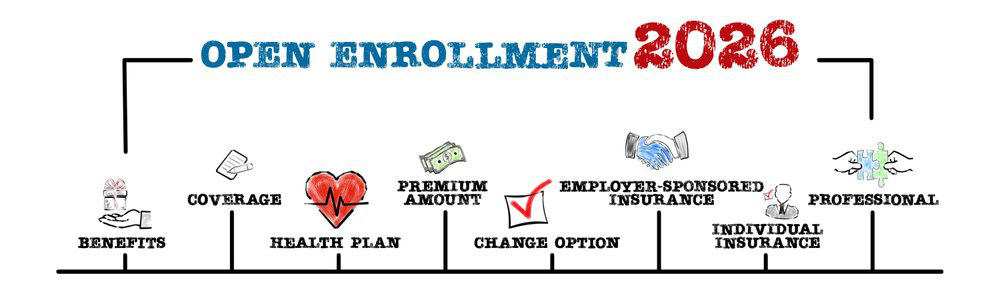
The 2026 healthcare pricing lists are coming out, with costs expected to rise by an estimated 18%, according to the Peterson/KFF Health System Tracker. That’s the highest cost level since 2018, the Tracker reported.
Affordable Care Act prices are set to soar next year, with an expected 18 percent cost rise, according to the most recent Peterson/KFF HealthSystem Tracker. The Tracker, which covers 312 U.S. insurers from all 50 states, represents the most significant cost level since 2018.
“The healthcare price surge is being driven by multiple factors, including medical cost inflation, higher drug costs, and an increase in hospital and doctor visits among enrollees,” said Whitney Stidom, vice president of consumer enablement at Salt Lake. City-based eHealth. “With federal subsidies expected to be reduced for many Americans who get insurance through an Affordable Care Act plan, it’s key to begin preparing now and seek expert guidance to review the various plan options when the open enrollment period begins this fall.”
With soaring prices casting a shadow over the U.S. healthcare market as Open Enrollment rolls out on November 1, what are the other significant issues facing American consumers and the healthcare insurance market?
What To Expect On the ACA Open Enrollment Date
U.S. government rules on income level limits largely remain in effect for 2026, with Americans earning up to 400% of the federal poverty level (approximately $62,000 per year for an individual or $128,000 for a family of four in 2025) still qualifying for subsidy assistance. “Subsidies work on a sliding scale, so those at the top of the income spectrum receive less help while those at the lower end may effectively pay no monthly premium at all,” Stidum said.
Enrollment-wise, ACA plan enrollees should keep their eyes open for letters or emails from their health insurance companies this fall.
“These letters should advise them of any upcoming rate increases or changes to benefits,” Stidum noted. “If their 2025 health plan will no longer be affordable, or if their coverage needs have changed, people should make the most of the open enrollment period. In most states, enrollment runs from Nov. 1 to Dec. 15, with coverage under new plans beginning Jan. 1, 2026.”
During open enrollment, ACA plan enrollees should review their coverage options and apply for subsidy assistance through a licensed private online marketplace or a government-run health insurance exchange.
“People should look at the monthly premiums, the prescription drug coverage, and the out-of-pocket costs they may face when they receive medical care,” Stidum added. “All of those issues are important to consider when trying to choose the optimal plan.”
Federal Tax Credits Expiring
Insurance professionals are bracing themselves for the anticipated expiration of enhanced health insurance premium tax credits throughout the ACA exchanges.
ACA healthcare tax credits are set to expire at the end of calendar year 2025, taking the expanded structure of the premium tax credit with them. The tax credit expansion was initially authorized by the American Rescue Plan Act of 2021 and extended under the 2022 Inflation Reduction Act through the end of this year. The policy shift is expected to hit middle-class ACA consumers hardest, as millions of Americans won’t only lose their tax credits but also face higher premiums.
“The ACA is only affordable if you qualify for subsidies and stay within the system’s rigid parameters,” said Tarek El Ali, founder at Smart Insurance Agents in Chicago, Il. “But one single income fluctuation, one provider network change, or one prescription switch can financially destroy people.”
El Ali said he’s seeing more clients choosing catastrophic plans or going uninsured because the “affordable” plans aren’t actually usable. “For 2026, I predict the subsidy cliff will hit harder as pandemic-era improved subsidies fully phase out,” he noted. “Families earning just over 400% of the federal poverty level will face brutal premium increases. The marketplace works for the poorest and richest, but the middle class is getting squeezed out completely.”
According to the Congressional Budget Office, allowing the ACA tax credits to expire would boost the U.S. uninsured by 4.2 million people over the next 10 years, putting even more pressure on the ACA model.
One potential ‘time bomb’ is the expiration of the federal tax credits that made premiums more affordable during the pandemic.
“Many families will have their monthly premiums escalate by hundreds of dollars without those increased credits,” said Robert Tsigler, an attorney at New York City-based Robert Tsigler, PLLC. “To a family that is already very budget-conscious, even an addition of $150 to $200 per month can’t be ignored.”
Tariff Pressures Continue
Even into 2026, drug and supply costs are likely to experience some upward pressure from tariffs or import stresses.
“For instance, generic drugs could see a 3‑8% boost in price changes, which could be tacked on to co‑pays or plan pricing,” said Guillermo Triana, founder and CEO at PEO-Marketplace.com in Miami, Fla.
Specialty drugs are somewhat insulated but are still subject to upward price pressure. “Vaccines are covered under ACA as an essential health benefit, so most marketplace plans will have to cover CDC‑recommended vaccines (e.g., flu, COVID, etc.),” Triana said. “If there’s a state law mandating a particular vaccine (school entry, for example), insurers generally will comply with that mandate as well. Precisely how that is covered, whether by copay or deductible, will vary from plan to plan.”
All ACA‑covered vaccines are also covered under the ACA preventive care rule. “Flu, COVID, HPV, tetanus, etc. would not cost you anything unless you go out‑of‑network or to a retail clinic where you may see an admin fee,” Triana noted. “The best way to avoid the stress is to get those shots from an in-network provider.”
On Medicare and Medicaid Cuts
In recent years, the ACA has expanded coverage through Medicaid expansion, Marketplaces, and preexisting-condition protections, and it continues to reduce the uninsured rate. Now those expansions, particularly with Medicare and Medicaid, are at risk.
“As coverage losses from Medicaid redeterminations after the pandemic protections ended, millions have been disenrolled during the unwinding,” said Lisa A. Cummings,
attorney and executive vice president at Cummings & Cummings Law in
Dallas, Tx. “For Medicare, 2026 brings higher projected Part B premiums and deductibles, even as plan payments rise, pressuring beneficiaries rather than program funding lines.”
Attending physicians view the Medicaid per capita caps as catastrophic, with annual funding cuts of 25%-to-30 % over the next decade, based on CBO estimates.
“States also propose to reduce postpartum coverage of 12 months to 60 days,” said Dr. David Ghozland, a practice owner and OB/GYN specialist in Orange, Cal. “The onset of most of the severe complications of the mother, such as bleeding, extreme depression, and infections, are revealed between the third and sixth months of delivery.”
Ghozland also views the new Medicare payment practice structure as ‘frustrating’.
“The payment made to physicians remained the same as in 2001, but my practice expenses increased by 40%, he said. “With more cuts, it will reduce the number of doctors who will accept Medicare. The older patients who require prolapse repair or to treat incontinence, for example, will not find surgeons willing to attend to them.”
Are There Higher Healthcare Costs On the Horizon?
U.S. healthcare consumers can expect insurance premiums to continue rising as subsidy buffers expire and carriers must adjust prices to account for inflation across the healthcare supply chain.
“Prices are absolutely on the rise,” said Randy Lobur, growth marketing manager at Action Benefits in Southfield, Mich. “Some of the latest figures put the average rate filing at an 18% increase, and that’s without considering Congress’s inaction on expanded premium tax credits. If those credits expire, consumers who are using those credits could be paying up to 75% more out of pocket for their premiums in 2026.”
Some ACA tiers will be price-impacted more than others, healthcare experts say.
“Middle-tier Silver plans will probably see the biggest increases since they are the ones that have to attract subsidy-qualified buyers and unsubsidized buyers,” Triana said. “My bet is that the premiums won’t stabilize until the federal and state regulators line up funding rules for those in the middle.
Until then, carriers will probably adjust their networks and/or benefit tiers to mitigate their losses. “This upcoming enrollment period will favor those who treat plan selection as a business decision versus a checkbox,” Triana added.
It’s unlikely to make budget-restricted consumers feel any better, but Lobur believes ACA coverage remains affordable, considering health insurance is what it’s intended to be: a financial product that protects enrollees from catastrophic financial losses.
“However, deductibles and out-of-pocket maximums can absolutely look daunting when you’re shopping around,” Lobur noted. “Consumers who don’t like the premiums they’re seeing might consider purchasing lower-premium plans with higher deductibles and out-of-pocket maximums.”
In most cases, those expenses “can be offset by Health Savings Account contributions, or with supplemental coverage like Critical Illness or Accident products, which can pay a lump sum when health issues arise,” Lobor added.
Tips on Maximizing Your ACA Health Experience
If you already have an ACA plan, the renewal process is still the same: sign in, confirm your information is accurate, and see if there are any changes you need to make.
“Premiums, deductibles, and plan networks do all adjust from year to year,” Triana said. “Some providers drop or switch tiers, so if you ignore it and let it auto‑enroll, you might lose a new subsidy opportunity or get stuck on a plan you no longer want.” Yet even if you do auto‑enroll, pay close attention. “It’s worth your time to at least glance at what changed in the plan,” Triana added.
Selecting a plan is primarily based on your anticipated usage rather than the cost.
“For example, if you visit two or more physicians a year, consider skipping bronze,” Triana noted. “Gold plans are pricey until you have a $2,000 deductible in March and are covered for the rest of the year.”
“It’s illogical to save $80 per month on a premium only to pay $300 more in prescriptions,” Triana said. “Concierge services are available if you are in over your head, but for most people, 30 minutes of review time is plenty.”
Looking ahead, US healthcare consumers should brace for the worst in 2026, especially if the ACA plan subsidy issue remains unaddressed.
“Premium outlook hinges on whether enhanced credits are extended,” Cummings said. “If enhanced credits lapse after 2025, average Marketplace premium payments would more than double for many.”
The best ‘next steps’? Due diligence is key for ACA users.
“Consumers should become familiar now with the enrollment period and how to find the information; pre-check networks and drugs to the extent possible, and plan for increased premiums for 2026,” Cummings advised.
The federal marketplace typically opens in the fall and runs into mid-January. Exact dates for 2026 may vary by state-based exchange, so check your state’s marketplace or HealthCare.gov for final dates. Enrolling by the early December deadline usually ensures coverage starts January 1.
Expect routine updates to premiums, plan networks, formularies, and subsidies. Some states may adjust their enrollment windows and special enrollment rules. Always review 2026 plan details—benefits, out-of-pocket costs, and in-network providers—before you renew.
You may qualify for a SEP if you experience a qualifying life event such as losing coverage, moving, getting married, having a baby, or a significant change in income. SEPs are time-limited, so file your application promptly after the event.
Yes. You can compare options and switch plans during Open Enrollment. Review total costs (premiums plus deductibles and copays), covered drugs, and provider networks before you submit your new selection.
There is no federal penalty for going without coverage, but some states and DC have their own individual mandates and penalties. Check rules for your state before opting out of coverage.
HealthCare.gov serves states that use the federal marketplace. State-based marketplaces run their own websites and may set different enrollment windows or extra plan options. Your eligibility for savings works in either system based on income and household size.
If you enroll by the early December cutoff (varies by marketplace), coverage generally begins January 1. Enrollments completed later in the window usually start February 1 or March 1, depending on your marketplace’s rules and payment timing.
Premium tax credits lower monthly premiums if your household income falls within eligible ranges. Cost-sharing reductions are available on Silver plans to reduce deductibles and copays for qualifying households. Update your 2026 income estimate to get accurate savings.
Written by
The insurance trends for Fall 2025 are all about transition – be it responding to a shifting federal environment, or even adapting to the coming AI wave. The leaves are getting ready to change and so are several areas of the insurance industry.
Insurance is being impacted by several federal policies in fall 2025. The One Big Beautiful Bill Act changed several areas of the Affordable Care Act, as well as Medicaid. Tariffs also have the potential to ripple through several areas of the insurance industry. And changes to the federal approach to vaccines could also upend some aspects of insurance coverage.

Health Insurance
The highest profile impact of the One Big Beautiful Bill Act, which was passed earlier this year and signed into law was the changes it made to Medicaid. The law made cuts to several aspects of the program, and implemented new requirements to states, providers, and recipients.
One of the biggest changes was the so-called community engagement requirements. The law now mandates that many, if not most Medicaid recipients do 20 hours a week of paid work, education, or volunteer time in order to qualify for the federally funded health plan.
That requirement does not apply to parents of young children or the disabled or medically frail individuals, and it exempts several other categories of people with certain medical conditions.
The law also mandates that states do eligibility checks on the people it enrolls every six months, meaning every person enrolled would risk losing their coverage twice every year if they do not properly comply with the paperwork.
In 2028, Medicaid will also begin requiring a cost-sharing provision for many enrollees, similar to private insurance copays.
The law also tightens rules about which non-citizens qualify for Medicaid, putting many green card recipients and asylum seekers at risk of losing their coverage.
The One Big Beautiful Bill also made changes that will impact the Affordable Care Act.
For one, Congress opted to not extend the expanded premium subsidies that were implemented during the pandemic, meaning premiums are set to go up for most ACA plan holders beginning next year.
The law also shortened by one month the open enrollment period during which people can sign up for an ACA Marketplace plan.
It also slashed funding for the workers who help people find an appropriate policy, called navigators.
Many industry observers worry these changes will compound to mean that fewer people will be protected by the Affordable Care Act than had been covered in years past.
Another area industry watchers are looking with a warry eye is the approach the federal government is taking with vaccines. According to the Affordable Care Act, any vaccine recommended by the Advisory Committee on Immunization Practices needs to be covered by ACA compliant plans without any charge to the patient.
That is significant because Health Secretary Robert F. Kennedy Jr. replaced all the members of that committee. If those new members step back which vaccines are recommended, insurers will no longer be mandated to cover them. Insurers could still voluntarily cover them or cover them because of the agreements between the insurers and the private companies that buy their policies, but the federal mandate would be gone.
Tariff impact
As President Donald Trump continues to levy tariffs on countries across the globe, many of those taxes have the potential to trickle down to the insurance industry.
In the realm of property and casualty insurance, tariffs have the potential to raise post-claim prices, as well as the costs of the protected assets, which could then translate to higher premiums.
For example, with an auto policy, if an imported truck costs more to buy in the first place, then a comprehensive and collision auto policy protecting that vehicle would cost more, because replacing it would cost more.
And if that vehicle were to get into a crash, the imported auto parts would cost more, leading to a higher repair bill, and consequentially, higher premiums.

Even if the vehicle and the parts were manufactured domestically, higher raw material costs could also translate to higher consumer costs, and subsequently, higher premiums.
The same scenario goes for homeowners insurance and other building insurance, which would be affected by higher steel, lumber, copper, and other material costs.
The effect isn’t limited to property and casualty lines, either. Health insurance also stands to see higher prices from tariffs.
Just like higher component prices drive up auto premiums, many parts of the medical economy are also imported, whether that is large diagnostic equipment, or lowly IV bags and surgical gloves. And all of those higher prices could translate to higher reimbursement costs for health insurers, which can then lead to higher premium prices.
Pharmaceuticals have their own areas of concern. For one, Trump has said that an announcement regarding specialized tariffs targeting imported finished medicines will be announced soon. Any increase in underlying prescription costs will be borne by the insurers who have to cover them.
But it isn’t just imported finished medicines. The active pharmaceutical ingredients – the raw materials that go into medications – are almost all imported, even if the medicine is manufactured domestically. Higher raw materials costs lead to higher finished goods prices, which could all trickle down to the premium.
AI and Insurance
Corporate earnings reports are rife with how artificial intelligence is sweeping nearly every corner of the economy, and the insurance industry is no different.
While state insurance regulators may limit precisely how artificial intelligence, large language models, machine learning, and the like can be integrated into various areas of the insurance value chain at the moment, industry leaders are discussing many places they would like to see it introduced quickly.
The first areas of the insurance ecosystem that are most implementing artificial intelligence are also the areas that have, in the past, been outsourced abroad. While in years past a call center in India may have fielded customer calls and done basic back-office functions, things like AI chat bots and language recognition models are stepping in now. But the future of the technology has a long runway.
One of the areas ripe for AI innovation is underwriting. With some policy types, such as life or commercial, AI’s ability to digest huge data sets – such as social media feeds, customer reviews, and other big data sources – could help write policies with rates hyper customized to each policyholder’s risks and do it in mere moments.
With auto insurance, an AI-powered insurance app could integrate with the vehicles’ navigation systems to offer up real-time insurance pricing depending on which route was chosen that morning, steering the driver to lower traffic – and lower risk – routes. And if the driver were to get into an accident, an AI-powered app on the driver’s smartphone could integrate data from the vehicle’s sensors, along with photos of the damage uploaded on the spot, comparing it with current market pricing data, to give claims estimates in near real time.
In the back office, AI tools could take over a lot of the tedious work, such as writing coverage opinions, or processing prior authorizations. And since AI doesn’t get tired, it could do the work around the clock.
And once claims are filed, AI could easily comb through the endless reams of data, looking for fraud in ways that could slip past a human examiner.
While these are all rosy scenarios, AI critics warn that as the technology is moved into places like underwriting and rate setting and claims processing, a darker side could emerge. AI tends to double down on what it perceives as trends, making it uniquely susceptible to biased outcomes. In the insurance world, bias against a protected class isn’t just bad business. It is illegal. And when it comes to decisions made by AI, many are done in a so-called black box, meaning it isn’t obvious why one policy was priced one way, as opposed to another.
Still, AI could be a valuable tool, not just in helping insurance on the back end. It could also become a valuable risk-management tool. Many vendors are already feeding information, such as aerial and satellite photography into AI models to evaluate roof conditions and wildfire risks – meaning if used well, it could actually avoid claims in the first place.
Season of change
As Fall 2025 unfolds, the insurance industry is navigating a season of transition on multiple fronts. But insurers must also keep a close eye on the natural environment. With hurricane season still peaking into late fall, and wildfire risks intensifying in the West, weather-related catastrophes remain a looming uncertainty that could reshape balance sheets overnight.
The months ahead will challenge insurers not just to price risk accurately, but to help families and businesses weather both economic shifts and the storms — literal and figurative — that lie ahead.
Michael Giusti, MBA, is an analyst for InsuranceQuotes.com
It adds 20-hour weekly community-engagement requirements for many recipients, semiannual eligibility checks, future cost-sharing (starting 2028), and tighter non-citizen eligibility.
Parents of young children, disabled or medically frail individuals, and several other medically exempt groups.
Enhanced premium subsidies end, open enrollment is shortened by a month, and navigator funding is cut—likely reducing enrollments and raising costs for many.
Yes. If ACIP recommendations roll back, ACA plans may no longer be required to cover some vaccines at $0, though insurers could still choose to cover them.
They can. Higher vehicle, parts, and building-material costs push up repair/replace expenses—which typically flow into premiums.
Yes. Medical equipment, supplies, and even pharma ingredients are often imported; higher input costs can translate into higher reimbursements and premiums.
Customer service and back-office tasks, with rapid expansion into underwriting, real-time pricing, claims estimation, and fraud detection—alongside bias/“black box” concerns.
Late-season hurricanes and Western wildfire risks—plus economic shifts that may impact premiums and coverage choices.
by Lauren Pezzullo
What to Do When You Disagree with an Insurance Claim Decision
You filed your insurance claim, waited for the decision—and then got the bad news. It was denied, or paid out way less than you expected. So what now?
First things first: don’t panic, and don’t assume this is the end of the road. You have the right to challenge an insurance company’s decision, and there’s a clear process to help you do it. Whether it’s health, auto, home, renters, or life insurance, the steps are surprisingly similar.

In this guide, we’ll cover why claims get denied or underpaid, the steps to dispute a decision, sample scripts for appeals, common mistakes to avoid, and how long the process usually takes. Let’s dive right in!
Step 1: Read the Denial or Payout Letter Carefully
Before you do anything else, start by reading the letter your insurance company sent. Most denial or payout letters should tell you:
- The amount approved (if anything)
- Why the claim was denied or reduced
- What your rights are or what your next steps should be if you want to appeal
Quick tip: Insurance companies, especially health plans, have to tell you why a claim was denied, and they’re required by law to explain it in writing. If their explanation doesn’t make sense, call and ask for clarification in writing.
Step 2: Call and Ask for Details
Once you’ve reviewed the letter, your next move is to talk to someone at the insurance company. This isn’t about arguing your side right now. Instead, you’re just gathering information. Here’s a sample script of what you cant say:
“Hi, I received a denial letter for my [type of insurance] claim, and I’d like to understand what led to that decision. Can you walk me through the specific part of my policy or documentation that caused the denial?”
Make sure to take notes during the call, including:
- The name of the person you spoke with
- The date and time of the call
- What they said and what they advised you to do next
Sometimes, an insurance claim denial will result from something small, like a missing document, that you can fix right away. Other times, it might come down to your insurer interpreting the policy in a way you don’t agree with—which leads to the next step.
Step 3: Gather Your Supporting Documents
If your insurer still won’t budge after the phone call, it’s time to build your case. Here’s what you’ll need to collect:
- A copy of your full policy (including exclusions or endorsements)
- All emails, letters, or messages between you and your insurer
- Proof to back up your claim—photos, receipts, repair estimates, medical records, police reports, etc.
- Second opinions or expert reviews, if applicable
Look closely at your policy’s wording. For example, if your homeowners insurance says it covers “sudden and accidental water damage” and you’ve got evidence that’s exactly what happened, make a note of it in your appeal.
Step 4: Submit a Formal Appeal or Dispute
If the issue isn’t resolved after your call, you’ll want to submit a formal appeal or request for reconsideration. Most insurers have an internal appeals process you’ll have to follow. And if this is a health insurance claim, federal law actually requires them to offer one.
- How to submit it:
- Follow the appeal instructions in your denial letter
- Use the insurer’s online portal, if available
- Include your supporting documentation
- Be clear, professional, and stick to the facts
- What to include in your appeal:
- Your claim number
- A clear, professional explanation of why you believe the decision was wrong
- Specific references to your policy
- Any documents that support your case
- Example appeal letter intro: “To Whom It May Concern: I’m writing to formally appeal the denial of claim #123456 for [brief description]. Based on the terms of my policy and the evidence provided, I believe this claim should be covered. Please find the supporting documents attached.”
- End with a clear request: “I respectfully request a reconsideration of this decision and ask that a corrected payment or detailed explanation be provided within 30 days.”
Step 5: Know the Timeline
The amount of time you’ll have to wait for a decision depends on the type of insurance you’re dealing with, but here’s a ballpark timeline based on the type:
- Health insurance– 30 to 60 day wait (or longer for external appeals)
- Auto or Homeowners insurance– 15 to 30 days for a response (varies by state)
- Life insurance– Up to 60 days, sometimes longer
If you don’t hear back within that timeframe, follow up with a polite but firm reminder like this one:
“Hi, I submitted an appeal for claim #123456 on [date]. I’m following up to ask when I can expect a decision. Please let me know if any additional documentation is needed.
Step 6: Escalate if Necessary
If your insurer sticks to the denial, or ignores your appeal entirely, you still have options. Here’s what you can try next:
- State insurance department – File a complaint with your state’s insurance commissioner. They may be able to step in and investigate to help resolve the claim decision.
- Independent review (health insurance) – If your health insurance appeal is denied, you have the right to request review by an Independent Review Organization (IRO), an outside medical expert chosen by your state insurance regulator or HHS. The insurance company is usually obligated to go along with their decision. How to request one: Your denial letter will explain how to start an external review, but you can also find instructions through your state insurance department.
- Appraisal or mediation (homeowners/auto) – Most home or car insurance policies let you bring in a neutral person to help settle a dispute without going to court. In an appraisal, each side picks an appraiser, and those appraisers agree on a neutral umpire if needed. For mediation, your state insurance department can often connect you with a neutral mediator.
- Legal action – As a last resort, you can consult a lawyer—especially if your claim involves a significant amount of money. Just remember, legal action takes time and may not be worth it for smaller claims.
Common Mistakes to Avoid
Here are some helpful tips of what not to do:
- Missing deadlines – Always check how long you have to appeal, because some policies only give you 30 or 60 days to appeal a claim.
- Letting your emotions take over – Of course it’s frustrating to be denied, but an angry email will rarely help your case. Keeping things calm, factual, and professional will go a long way in helping your side.
- Skipping the fine print – Read your policy carefully—even the really boring parts. This may be where you find the exact language you need to support your appeal!
- Giving up too soon – Plenty of denials are successfully overturned, especially when backed by clear documentation and persistence.
Final Thoughts: Stay Organized and Persistent
Disputing an insurance claim decision isn’t fun, but it can absolutely be worth it. The key is to stay organized, calm, and persistent. Start by understanding the “why” behind the denial, then build a strong case based on your policy and supporting documents. Even if you don’t win your dispute, going through the process can teach you a lot about your coverage—and it might help you choose a better policy in the future. And if you are shopping for new insurance, keep an eye out for:
- Strong customer reviews (especially for the claims process)
- Clear and transparent policies
- Optional coverage add-ons that fit your needs
- Strong financial ratings
FAQ’s about Insurance Claims
Frequently Asked Questions
Why was my health insurance claim denied?
Common reasons include coding errors, missing documentation or preauthorization, out-of-network providers, plan exclusions, or filing after the deadline.
Can I appeal a denied claim?
Yes. Most plans allow internal appeals—and if that fails—an external, independent review when available in your state.
What documents do I need for an appeal?
Your denial letter, EOB, itemized bill, medical notes, referrals or prior authorizations, and a concise appeal letter summarizing medical necessity.
How long do I have to appeal?
Deadlines vary by plan and state. Check the denial letter for the exact window and submit as soon as possible to avoid missing it.
Will appealing affect my coverage?
No—appeals are a member right to challenge a determination and shouldn’t jeopardize your coverage.
Get Covered—Start with a Free Health Insurance Quote
No one wants to overpay for insurance, but the truth is, many people do—just because they don’t compare their options. A few minutes of your time could mean saving a lot. Get a free online insurance quote today and see how much you could save on your insurance.
Written by
For students heading off to college, there are insurance implications for many aspects of their back-to-school preparation. Students need to contend with health insurance, renters insurance, automotive insurance, and depending on their individual situations, they may potentially need to consider tuition insurance, life insurance, travel insurance, and even moving insurance.
We’ll break down these back-to-school options down one at a time here.

College Student Health
One of the first and biggest areas families need to think about when it comes to insuring their college students is their health. That’s true even if the family has perfectly fine health insurance back home.
If the student is going to school in the same metro area as the family, then staying on that family health plan is probably the best option. But that doesn’t mean they get to stop thinking about health insurance. That is because most universities require their students to carry sufficient insurance in order to enroll, and to make sure everyone is properly insured, those schools often automatically enroll every student in an insurance policy that partners with the school – whether they have a policy already or not.
These school-partnered plans are typically good, and often comparatively affordable plans. They cover doctors, emergencies, and prescriptions. But if the student already has health insurance, it can be redundant. If that’s the case, the student needs to show the school their proof of insurance, so the school-partnered plan is waived. If they don’t do that in the first week or so of school, the school-provided plan can be automatically charged to the students’ tuition bill. If the student shows proof of adequate insurance before that deadline, the school will waive that extra line item, which is typically several thousands of dollars.
On the other hand, if the student is going to school in an area far from home, the family’s existing plan may not actually be appropriate. That is because health insurance plans separate their providers into in-network and out-of-network providers. Access to the network also applies to pharmacies.
For most health plans, the in-network providers, which cost substantially less to use, are located geographically close to the policyholder’s home – typically the parents’ home city.
So, if the student is going out of state, or even to the other side of a big state, their parents’ policy may not be the best option, with the in-network providers likely being hundreds of miles away from their student.
If that is the case, then the school-partnered health insurance plan is a great place to start looking for other options, but it isn’t the only place.
Sometimes the parents can contact their insurance company and see if they can purchase an extended network, meaning the providers close to their child’s school may become in-network. Paying for an expanded network can sometimes be less expensive than adding an additional policy for the child.
Another option is to look at is an Affordable Care Act Marketplace plan. This is especially attractive if the parents are also on a Marketplace plan themselves. That is because even though they would have to purchase a new policy for the child, the way the federal government calculates policy subsidies, the amount the parents are paying is worked into the same equation as the child, so the students’ policy may not cost a whole lot more after the premium subsidies are figured in.
One key to keep in mind is that even though health insurance can typically only be purchased during open enrollment, moving to a new ZIP code is considered a qualifying life event, meaning that all policies will allow changes after a move away to school – as long as they are made within a tight window of the move.
Student Auto Insurance
If the student is a driver, auto insurance also needs to be top of mind.
Much like health insurance, the first option families need to consider is sticking with the parents’ plan. Piggybacking off a parent’s policy is almost always less expensive than having a teenager get their own policy.
If the student is going to school in town, not much needs to change, other than ensuring the agent applies a good-student discount.
If the student is moving out of town, letting the agent know where the vehicle will be is key.
If the student brings the vehicle to school, their rate could go up – or down, especially if the move is from a high-cost metro area to a low-cost rural school or vice versa.
It’s important to not skip letting the agent know about the move, though, or else there might be consequences or even refused coverage if there is an accident and the insurance company learns the vehicle was not being kept in the place that they rated it.
If the student opts to leave the vehicle at home while they go off to school, most insurance companies will offer a substantial discount because the vehicle will likely be just sitting in the driveway for most of the year. And if that is the case, families might also opt for a pay per mile vehicle telematics device for cheaper insurance rates, which they can plug into the parked vehicle in exchange for a much lower rate once the insurance company sees how seldom the vehicle is being driven.
Student Renters Coverage
Even though students aren’t starting out life with a house full of high-end possessions, getting renters insurance is more important than it might first appear.
First, even though they don’t typically have high-end art and jewels in their dorms, students do generally come to school with a valuable phone and laptop, not to mention a closet full of clothes, which would cost many thousands of dollars to replace.
If the student is moving into a dorm room, then their parents’ homeowners insurance would generally offer them some protection. However, a parents’ homeowners policy isn’t always the ideal option to protect a college student, for a number of reasons. First, the parents’ deductible would apply to any claim. And if the parents live in an area with costly homeowners insurance and have opted for a high deductible to keep policy premiums down, there might not be much coverage left if a $1,000 laptop were to get stolen. Second, if a student were to make a claim, that would be a hit against the parents’ claims history, which might hurt them when it comes time to renew.
And the parents’ homeowners policies will never cover their child’s possessions if they live in an off-campus apartment.
For those reasons, students often opt for a renters policy instead.
Since they are not covering a primary residence, premiums for a renters policy are typically very low – just a few hundred dollars a year in general. They also have correspondingly low deductibles, meaning a $800 phone could be mostly covered if it was inadvertently tossed off a fourth-floor balcony.
Families can shop renters policies from any agent who sells homeowners plans. They can also work with the company that partners with the university, which will often offer very competitive rates.
In addition to covering the students’ property, renters insurance has a few other nice add-ons. For one, it generally carries a liability portion, which would kick in if the student were to accidentally cause damage to someone else’s property – say they were playing hall sports and inadvertently knocked a drinking fountain off the wall, flooding the floor.
Renters policies also typically protect against defamation. So, if the student were to get into a social media fight with someone and take it a bit too far and falsely damage their reputation, the renters policy would potentially hire an attorney to defend the defamation suit and could help pay any judgement or settlement that might come from that.
Renters policies also typically include a medical provision, which would help pay for the medical bills of any guests in the home who are accidentally harmed, such asif a guest were to fall down the student’s stairs. The medical provision could cover the several-hundred-dollar bill from urgent care.
In the case of a mandatory evacuation, or if the student’s apartment were to get damaged, renters policies also cover loss-of-use. So, if the student had to stay in a hotel briefly, the policy would pay for those added living expenses.
Two things renters insurance do NOT cover is floods and earthquakes. If the student has a basement apartment in an earthquake zone, those separate policies would be worth buying in addition to the renters policy.
Student Life
In general, life insurance is meant to replace someone’s income if they were to die suddenly while someone else is relying on them. This makes life insurance policies ideal for young families. It also means that if the student is a young parent, or if they are a caregiver for someone else, a term life policy would be a good way to make sure those people were protected if something were to happen to the student.
There is also a niche situation where life insurance might make sense for a student, even if they are not a parent or caregiver: if the student’s parents are helping them launch their lives in the form of a loan that they expect to be paid back.
The parents might be taking out a private student loan for tuition or even cashing out retirement savings to help pay tuition or buy a first house or to help the student launch a business after graduation, with the expectation of getting paid back later. In this case, if the student were to die an untimely death, the parents would never get paid back. An inexpensive term policy naming the parents as a beneficiary makes sense here.
And since the students, by the nature of being young adults, tend to be in good health, their term policies would be very inexpensive compared with someone in their 50s trying to secure similar coverage.
Tuition Insurance
Families are investing thousands of dollars each semester for their children’s education. If something where to happen that kept the student from finishing the semester, there aren’t a lot of options to recover that investment.
If the family were to see these roadblocks coming soon enough, they could have the student withdraw from the university for a full refund. Unfortunately, the window to do this is vanishingly small. Often this must be done within the first week or two of class. After that, the only other option is to withdraw midway through the semester, where they may only be entitled to a pro-rated refund. And not all schools even offer refunds at this point.
So, unless the family were to luck out and be able to withdraw quickly, they would lose the entire semester’s tuition payment.
This is where tuition insurance comes in.
Tuition insurance protects families if their student were to get sick during the semester, or if they were hurt in an accident and couldn’t finish the semester. Tuition insurance often also kicks in if the tuition payer were to die or lose their job.
Tuition insurance covers sudden, unexpected illness that would keep the student from continuing to study. It also covers chronic issues that get worse and make studies impossible.
Tuition insurance is often offered as an option by the school, which partners with a private provider who writes the coverage. Some specialty insurers also sell these policies directly to families.
Tuition insurance typically gives a full refund for tuition no matter how far into the semester the crisis happens, and it also often covers the costs for room and board and fees.
Many policies also have add-on services, such as travel and transportation assistance in the case of a covered event, and many offer a service to help get the student’s vehicle home if they were to fly home unexpectedly for a covered reason.
Student Travel
Many epic trips were born from a conversation in the quad — whether that is a spring break blowout or a European backpacking adventure.
In some cases, these trips would benefit from travel insurance. In other cases, students might do better taking on the risk themselves.
Travel insurance reimburses travelers for non-refundable up-front costs that were lost because the trip was called off for a covered reason. This could be because the travelers fell ill, or because a wildfire swept through the town they were about to visit.
But that isn’t all a travel policy protects students from.
Travel policies also protect their luggage. So, if their checked bag is lost, the travel insurance would kick in and reimburse them for their lost clothing.
If the trip were delayed for a covered reason, the travel policy may step in and help with housing costs and food and then help re-book the trip to get it back on schedule.
But one of the biggest reasons students might consider travel insurance is if their adventure takes them out of their home health insurance coverage network.
If the student were to travel to Europe and then fall ill, the travel insurance policy would help find and pay for a doctor or emergency room, even in places where their home health insurance may not reach.
All that said, if the trip is less exotic, travel insurance may be overkill. For example, if the spring break trip is just a quick road trip and hotel stay in Florida, there isn’t much in the way of non-refundable up-front costs a travel policy might pay for.
And if it is just a flight home, the airline will typically have enough of a refund policy to keep the student protected.
Moving In
When it comes to moving into the dorm or the apartment, it is important to know that a homeowners or renters policy likely won’t help if all their worldly possessions are ruined. That is because these policies are meant to kick in if a covered event were to happen to the home. But in the case of a moving van – the possessions are not in the covered property.
Some policies protect against theft away from home. So, if the van were to be stollen, it could be covered.
But if reckless movers were to smash a television, another type of coverage would have to kick in.
When it comes to moving, there are generally three types of protection: Released Value Protection, Full Value Protection, and Third Party Insurance. These first two sound similar, but they are very different. Most moving companies automatically offer released value protection as an included cost of the move, but it comes with a big catch. Its protection is based on the weight of the object, not the value of the object. So, if a 10-pound flat screen TV were broken, released value protection would only reimburse $6 – nowhere near enough to replace the item.
Full Value Protection is also offered by the movers, but it is a paid upgrade. It is more generous, but its coverage is typically limited to $100 a pound for each item’s value.
Third party insurance protection is a separate policy that the customer has to buy. The moving companies often offer these policies as well, but they are written by third party insurers and tend to be the most generous when it comes to covering damaged items but are also the costliest.
K-12 Insurance for Your Kids
College students aren’t the only ones who need to be thinking of health insurance.
When pupils are heading back to their K-12 classrooms, there are a few places where parents need to make sure their insurance is secure.
First, if the parents don’t have a health insurance plan that covers the child, they might look into the Children’s Health Insurance Program. That is a federally funded program run by each state to ensure that middle- and low-income children are covered with adequate health insurance. And making sure they have coverage is essential, especially if that child is the kind who is likely to fall from the monkey bars and break an arm, or even just come home with a case of the class sniffles.
One major advantage of the CHIP program is that it has rolling open enrollment, meaning families can sign up at any point of the year, as long as they qualify.
Health insurance is also important for the back-to-school vaccines.
All Affordable Care Act compliant health insurance plans, including CHIP and Medicaid, cover required vaccines at no cost to the patient.
And if the child is looking to get involved in sports, parents can use the child’s annual well-child visit – which is covered at no cost to the family – to have the doctor fill out the physical forms.
If the family forgets to get the physical at the annual visit, they might have to schedule a separate visit, along with a separate co-pay to get those physical forms filled out. And most schools require students to have a new physical for every year they participate in sports.
Dorm residents are often covered partially by a parent’s homeowners policy for personal property, but limits and deductibles apply and liability may not be included. A low-cost student renters policy can close those gaps and cover off-campus housing.
Staying on a parent’s policy is usually cheaper if the student lives at home part-time and drives a family car. If the student owns the vehicle or lives full-time out of state, a separate policy may be required by the insurer.
Tuition insurance can reimburse nonrefundable tuition and fees if a student withdraws for covered reasons like serious illness or injury. Policies vary and often exclude academic or disciplinary withdrawals.
Yes. Travel insurance can bundle trip cancellation, interruption, medical, and evacuation coverage for study abroad. Check school requirements and any overlap with your health plan.
by Brian O’Connell
Cuts to the US government’s biggest disaster relief agency could spell trouble for insurance companies and consumers.
The U.S. Federal Emergency Management Authority seems like it’s on its last legs, with agency leaders cutting $1 billion in state and local grant funding, and with President Donald Trump’s plan to phase FEMA out completely later this year.
In March, President Trump signed an executive order calling for a complete overhaul at FEMA, and since then, the administration has taken stronger measures to cancel the agency completely. Presumably, Team Trump will move the federal disaster relief program, along with billions of dollars in funds, down to U.S. state and local governments.
The overhaul is likely to have a big impact on commercial and residential insurance, and the effect is likely immediate, as major weather events continue to stack up insurance-related losses.
“FEMA plays an essential role in disaster mitigation, preventing losses before they occur, and the USDA supports community resilience in forest management that are very important,” said Robert Gordon, senior vice president of policy, research and international for the American Property Casualty Insurance Association in a recent government hearing titled “Examining Insurance Markets and the Role of Mitigation Policies. “Those programs are essential for effective mitigation and cannot be easily replicated by the states or private industry.”
In his testimony, Gordon noted that US homeowners, in particular, would bear the brunt of government-backed disaster recovery budget reductions, as homeowners paid $1.11 in insurance claims for every $1 paid in claims in 2023.
“Homeowners insurance rates increased because homeowners’ losses increased even more,” Gordon said. “The primary cost factors were record inflation, even higher inflation for building materials, and more expensive buildings being built in disaster-prone areas.”
Insurance companies are unlikely to lead any industry efforts to mitigate FEMA budget cuts. According to ICF, a data analysis company, insured catastrophe losses globally reached $50 billion in the first quarter of 2025, making it the second-highest Q1 total on record.
Cracks Emerging In FEMA’s Foundation
Insurance industry experts say FEMA’s operating condition has been deteriorating in recent years, and insurers have tried to fill the breach. Take US farmers, who’ve suffered through hurricanes, wildfires, and floods, with little help from FEMA and insurers.
“The biggest issue farmers face is FEMA’s narrow coverage scope,” said Casey Love, founder of NY Farm Insurance Company, an independent insurance agency in Honeoye Falls, New York. “They don’t cover operational losses or specialized farm equipment.”
Love points out that when a client’s $200,000 combine was destroyed in flooding last year, FEMA covered maybe 30% while his farm insurance handled the rest. “Without proper farm coverage, he would’ve been bankrupt.”
As always in Washington D.C., funding, specifically the lack of it, is the primary problem. “For agricultural properties, standard flood insurance through FEMA caps at $500,000 for commercial structures, which doesn’t even cover one modern dairy barn,” Love said. “I’ve seen clients with $2 million in farm buildings find they’re massively underinsured when relying on federal programs alone.”
The larger problem is that when FEMA’s budget is cut, insurers step in, but at a higher price for customers.
“I’ve managed over $1 billion in Massachusetts property insurance and seen how FEMA cuts directly impact private insurance costs,” said Mikhail Kovalev, of Kovalev Insurance Agency Inc. in Newton, Mass.
“When FEMA reduces disaster relief funding, insurance carriers immediately recalculate their risk exposure and raise premiums 15-25% in flood-prone areas. We’re already seeing this in coastal Massachusetts communities.”
The biggest consumer trap is assuming FEMA will cover what private insurance won’t. “During recent flooding in the Greater Boston area. “I watched clients find FEMA’s $37,000 maximum individual assistance barely covered temporary housing costs, let alone property restoration. Meanwhile, their homeowners’ policies excluded flood damage entirely.”
U.S. States Are Pushing Back
While FEMA’s fate is being decided in Washington, D.C., state and local governments are lobbying for more disaster relief funds from Uncle Sam.
“We’re seeing political resistance from high-risk states, like Florida, California, and Texas, where officials are pressuring Congress to shore up FEMA funding,” said Christopher Migliaccio, founder at Warren and Migliaccio, LLC, a Richardson, Texas law firm.
Some state legislatures are also exploring localized emergency relief funds or public-private partnerships to bridge the gap. “However, success is uncertain,” Migliaccio said. “With a divided Congress and growing federal debt concerns, any meaningful restoration of FEMA funding faces an uphill battle. For consumers, that means potential gaps between what FEMA used to provide and what’s realistically available today.”
Meanwhile, advocacy groups are starting to challenge FEMA’s claim denials and how funds are allocated. “Whether this pressure leads to real change may depend on how severe the next disaster is and how much attention it gets in the media,” said Jordan Blake, director of operations at Shoreline Public Adjusters in Naples, Florida.
Blake believes that in the near term, not much is likely to improve on the FEMA front.
“Delays will continue, local agencies will remain overwhelmed, and homeowners will be left trying to figure things out on their own,” he noted. Long term, FEMA may shift into more of a last-resort option rather than a reliable source of relief. Insurance will become more necessary, but also more expensive and more complicated to get. “That leaves low-income and uninsured families at the greatest risk,” he added.
Insurance consumers, particularly homeowners, are already seeing this play out.
“Since the recent floods in Texas, we’ve heard from several homeowners who had their FEMA claims denied or delayed for weeks,” Blake said. “Others were underinsured and shocked by how little their policies actually covered. Additionally, insurance carriers are denying more claims and lowering payout amounts.”
Consumer Insurance Tips For Homeowners Recovering From Disasters
Homeowners in Texas, California, North Carolina, and other locales dealing with the fallout of hurricanes, fires, and floods can’t afford to wait for FEMA and federal and state governments to get their act together. They need to take action now, with FEMA and their insurers.
“If you’re filing a FEMA claim, document everything, even before disaster strikes,” Blake advised. “Take photos of your home and belongings, keep receipts, and record videos of any damage. Collect written estimates from licensed professionals.”
In general, the more solid your evidence, the better your chances of getting approved. “If you’re uninsured, you may still qualify for temporary housing or small grants, but the process is much harder,” Blake noted. “You’ll usually need to show that other sources of help were denied first.
Additionally, read your insurance policy thoroughly.
“Know what’s excluded,” Blake said. “Make small upgrades where you can, things like roof reinforcements, sump pumps, or flood vents can make a difference.”
Unfortunately, homeowners need to understand how to respond in a disaster situation, but it’s in their best interest to keep asking for help. “Don’t go through the process alone,” Blake said. “Many people leave money behind simply because they don’t know how to advocate for themselves. Having an expert on your side can make all the difference.”
That’s why it’s advisable to stay in close communication with both FEMA and your insurer after a home-related disaster. “Use FEMA’s DisasterAssistance.gov portal and ensure your application is complete and timely; delays or errors often result in rejections,” Migliaccio said.
If you’re uninsured, you’re not out of luck, but your assistance options are more limited. “FEMA may offer grants for temporary housing and basic repairs, but these are capped and don’t provide the same coverage as private insurance,” Migliaccio noted. “You may also be eligible for low-interest disaster loans through the SBA, but those are debts, not grants.”
For 2025 FEMA claims, document everything before cleanup begins, which is why Kovalev tells his clients to take video walkthroughs showing water levels on walls. “FEMA inspectors often arrive weeks later when evidence is gone,” he said. “Uninsured homeowners actually get priority for FEMA assistance, but you’re still capped at those low maximums.”
Kovalev also tells her clients to buy private flood insurance now, before it’s needed. “The 30-day waiting period means you can’t buy coverage when storms are already forecasted,” he said. “ I’ve written policies up to $2 million in coverage versus FEMA’s $250,000 maximum. That difference saves families from bankruptcy when a major disaster hits.”
Preparing For An Uncertain Future
The most prudent move for homeowners is to take proactive steps now:
“That means ensuring you have adequate flood and disaster coverage, and understand the limits of your protection,” Migliaccio noted. “Build an emergency fund. Know your rights when dealing with insurers or disaster relief programs. If your property is in a FEMA-designated high-risk zone, explore elevation certificates or mitigation improvements, which may reduce premiums or qualify you for state/local grants.”
In a future where FEMA’s role is uncertain, preparation becomes not just wise, it’s essential. “As legal professionals, we often encounter clients after the damage is done,” Migliaccio added. “The goal now is to ensure they’re positioned to weather the storm before it arrives.”